

SEO for a medical practice is all about showing up when local patients need you most. It’s the art and science of making your practice the most visible and trusted option when someone in your community pulls out their phone and searches for a doctor "near me."
Building Your Digital Foundation with Local SEO
For a medical practice, local search isn't just one piece of your marketing—it's everything. Patients are looking for two things above all else: trust and convenience. That search almost always starts right in their own neighborhood.
Think of your online presence like the sign on your physical office. If it's not clear, visible, and professional, potential patients are just going to drive on by. The goal is to be the first name they see when they search for "pediatrician in [Your Town]" or "dermatology clinic near me." You want your practice to pop up right away, complete with a map, glowing reviews, and a phone number they can tap to call.
Master Your Google Business Profile
If you do only one thing for your local SEO, make it this: perfect your Google Business Profile (GBP). This is your digital billboard. It's that information-packed box that appears in Google Maps and on the right side of the search results, showing your hours, address, phone number, and those all-important patient reviews.
Getting this right is non-negotiable. It’s your first impression online.
- Fill Out Everything: Don't leave any field blank. Meticulously enter your practice name, address, phone, hours, services offered, and even the insurance plans you accept. Accuracy is paramount.
- Pick the Right Categories: Be specific. Are you a "Family Practice Physician" or a "Pediatrician"? A "Dermatologist" or a "Medical Spa"? Choosing the most accurate primary and secondary categories helps Google match you with the right patients.
- Show, Don't Just Tell: Upload plenty of high-quality photos. Show off your welcoming reception area, your clean exam rooms, your friendly staff, and the exterior of your building. This helps build a sense of familiarity and trust before a patient even picks up the phone.
The Critical Role of NAP Consistency
In the world of local SEO, consistency is currency. Your practice's Name, Address, and Phone number (NAP) needs to be absolutely identical everywhere it appears online. I'm talking about your website, your GBP, Yelp, Healthgrades, Zocdoc—every single listing.
Even a tiny difference like "St." versus "Street" or "Suite 200" versus "#200" can create confusion for search engines. This digital sloppiness signals a lack of authority and can seriously hurt your rankings.
A consistent NAP across the web acts as a series of verified votes of confidence. It tells Google that your practice is a real, legitimate, and established entity at a specific physical location. It’s the digital equivalent of having multiple trusted sources vouch for your address.
A solid local SEO strategy starts with these foundational elements. The following checklist covers the absolute must-haves for any medical practice looking to build a strong presence in their community.
Local SEO Foundational Checklist for Medical Practices
| Component | Action Item | Why It Matters for Patient Trust |
|---|---|---|
| Google Business Profile | Claim and fully optimize your profile with accurate hours, services, and photos. | This is often the first interaction a patient has with your practice. An incomplete profile looks unprofessional and untrustworthy. |
| NAP Consistency | Audit and correct your Name, Address, and Phone number across all major directories. | Consistent information confirms you are a legitimate, stable practice, reducing patient uncertainty about your location or contact details. |
| Online Reviews | Actively encourage and respond to patient reviews on Google, Healthgrades, etc. | A steady stream of recent, positive reviews is powerful social proof that you provide quality care and value patient feedback. |
| Website Location Pages | Create a unique page on your site for each physical office location. | This shows you are truly part of the local community and makes it easy for patients to find location-specific information. |
Completing this checklist establishes a powerful baseline, ensuring that when local patients search for care, your practice is not only visible but also presented as the professional, reliable choice they're looking for.
Harnessing Patient Reviews and Location-Specific Pages
Online reviews are a massive signal to both prospective patients and search engines. A steady flow of recent, positive reviews on platforms like Google and Healthgrades is proof of patient satisfaction. Google sees this activity and rewards practices that are clearly engaged and valued by their community with better visibility.
Another powerful tactic is creating dedicated pages on your website for each physical location or key service area. A page titled "Top-Rated Family Care in [Your Neighborhood]" directly targets local searchers and lets you pack it with content relevant to that specific community. This strategy works hand-in-hand with your other systems; for example, you can learn more about how to manage patient data effectively with the right practice management software.
The impact of getting local SEO right is massive. Healthcare decisions are, and will continue to be, deeply personal and local. Even with all the changes in search, a staggering 70% of patients still look for a doctor within just 10 miles of their home.
The results speak for themselves. One telemedicine clinic that doubled down on these foundational tactics saw a 75% increase in phone calls and a 110% jump in local search visibility in only six months. That's the power of building a solid digital foundation.
Creating Patient-Centric Content That Ranks
Let’s be honest: generic service pages that just list procedures don't cut it anymore. Today’s patients are informed and looking for real answers. If you want to succeed with SEO for your medical practice, you have to stop talking at potential patients and start a genuine conversation with them. It’s all about addressing their actual questions and concerns.
This is where you build real digital authority. At the core of this approach is something Google takes very seriously, especially in healthcare: E-E-A-T. That stands for Experience, Expertise, Authoritativeness, and Trustworthiness. Every single piece of content you publish needs to reinforce these four pillars. You’re not just trying to rank; you’re proving to patients and search engines alike that you're a credible, reliable source of medical information.
Uncovering What Patients Actually Search For
The best content always starts with listening. You need to get inside the head of a prospective patient and understand the exact words they use when they're worried about a symptom or looking into a treatment. They aren't typing "orthopedic surgical interventions" into Google. They're searching for things like "sharp pain in knee when walking up stairs" or "what to expect after ACL surgery."
These longer, more specific phrases are what we call long-tail keywords. While they don't get massive search volume individually, they are pure gold. Why? Because they reveal exactly what the person needs and face far less competition. Targeting these queries lets you connect with patients at the very moment they need your help.
So, how do you find these gems?
- Talk to your front desk staff. Ask them what questions they answer on the phone all day, every day. Those are your starting points.
- Look at your patient intake forms. What are the most common symptoms and conditions people write down?
- Use simple online tools. A tool like AnswerThePublic is fantastic for this. It literally maps out the questions people are asking around a topic, giving you a treasure trove of content ideas.
This process—from optimizing your online profiles to managing reviews—is the bedrock of a powerful local SEO strategy.
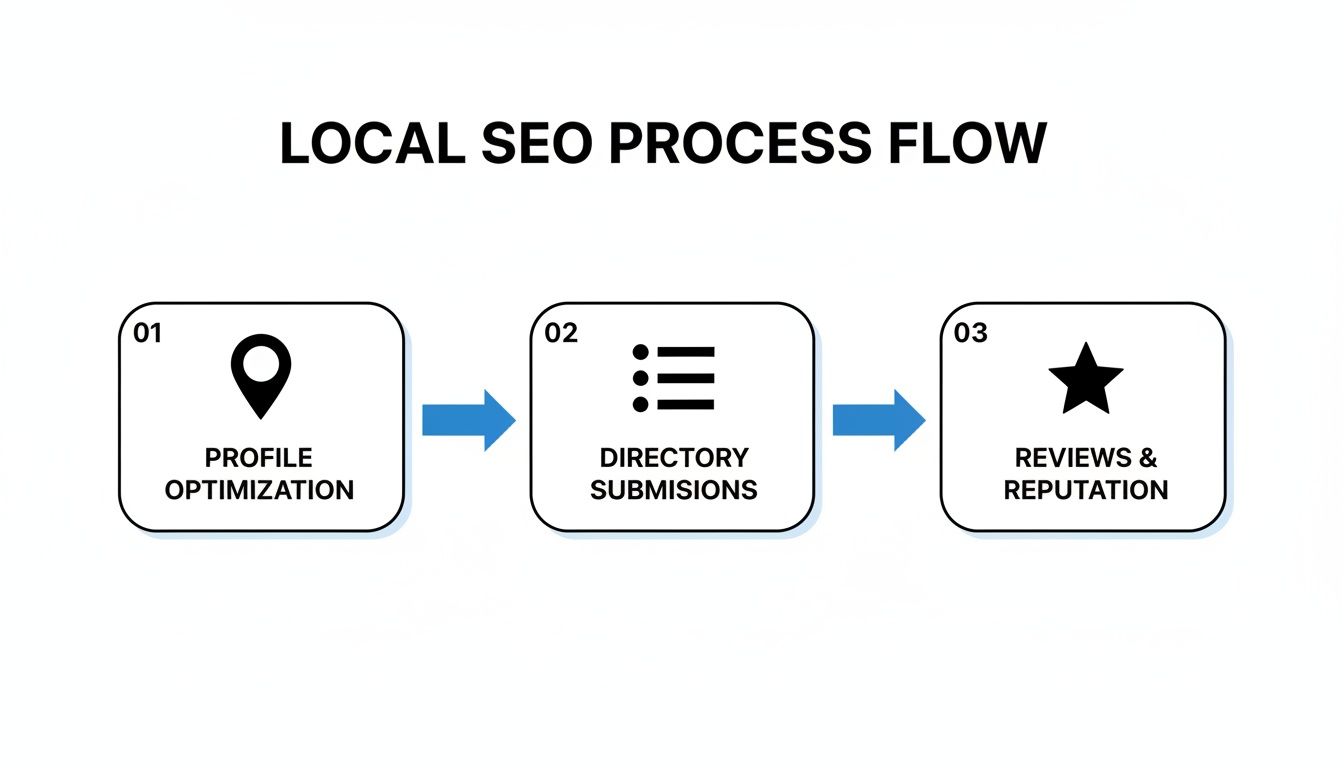
When you methodically build out your practice's digital identity—starting with your core business profile, ensuring consistency across directories, and actively managing patient feedback—you create a trustworthy and highly visible local presence that attracts new patients.
Building Topical Authority One Page at a Time
Once you know what your patients are asking, the next step is to create the single best answer out there. This is how you go beyond just having a website and become a true topical authority in your field.
I saw this work firsthand with a hernia repair center we worked with. They went all-in on E-E-A-T, long-tail keywords, and crafting incredibly detailed provider bios. The results were staggering. Over two years, they saw a 1,100% surge in organic website sessions, a 1,657% increase in the number of keywords they ranked for, and a 214% jump in new patient leads. This case is the perfect example of how directly answering patient questions fuels practice growth. You can dive deeper into the specific strategies they used by reading the full case study on medical SEO tactics.
Here's how you can put this same strategy to work for your own practice:
- Create Ultimate Procedure Pages: Don't just mention that you perform a procedure. Build a comprehensive resource that walks a patient through the entire experience. Cover everything from how to prepare, what happens on the day of, what recovery really looks like, and a detailed FAQ section.
- Write Genuinely Helpful Blog Posts: Use those long-tail keywords you found to create articles that answer specific questions. A post titled "5 Common Causes of Lower Back Pain and When to See a Doctor" will always outperform a generic one about "orthopedics."
- Craft Provider Bios That Connect: A bio should be more than a list of credentials from a CV. It needs to tell a story and build trust. Highlight a provider's specific experience, talk about their patient care philosophy, and mention any unique skills or techniques they bring to the table. This is where you really nail the "Experience" and "Expertise" parts of E-E-A-T.
Think of your website as the most helpful, knowledgeable member of your staff, available 24/7. It should anticipate patient questions and provide clear, reassuring answers, building confidence in your practice long before they ever step through your door.
By consistently creating content that educates, reassures, and demonstrates your deep expertise, you send powerful signals to Google. You’re no longer just another medical practice; you’re the definitive resource for your specialty in your community. This patient-first approach is the most sustainable and effective way to get to the top of the search results and stay there.
Mastering Technical SEO for Modern Search
Let's be clear: technical SEO for your medical practice isn't about learning to code overnight. It’s about making sure your website's foundation is rock-solid so search engines can easily find, understand, and—most importantly—trust your content. A technically sound site is the launchpad for every other SEO effort you'll make.
Think of it this way: without that solid base, even the most brilliant, patient-focused articles and service pages can end up invisible. Things like site speed, how your site looks on a phone, and security aren't just nice-to-haves anymore; Google uses them as direct ranking factors. Patients are looking for a fast, seamless experience. If your website is slow or a pain to use on mobile, they’re gone.

Speak Google’s Language With Structured Data
One of the most potent tools in your technical SEO arsenal is structured data, often called Schema markup. It’s essentially a special vocabulary you add to your website's code to explicitly tell search engines what your content is about. No more guesswork for them.
This is a game-changer for a medical practice. Instead of Google just seeing a name and an address on a page, you can use Schema to precisely label all the critical information.
To make your website's information crystal clear to Google, you need to use the right Schema markup. Here are the most important types for any medical practice.
| Schema Type | What It Communicates to Google | Practical Impact for Your Practice |
|---|---|---|
MedicalOrganization |
"This is a legitimate medical clinic, practice, or hospital." | Helps establish your practice as a verified healthcare entity, crucial for local search and map listings. |
Physician |
"This page is about a specific doctor, including their specialty and credentials." | Powers rich results like doctor profiles in search, building trust before a patient even clicks. |
MedicalCondition |
"This content authoritatively discusses a specific health condition we treat." | Signals expertise and can help your pages appear for specific, high-intent searches related to symptoms or conditions. |
MedicalProcedure |
"This page details a specific medical treatment or procedure offered here." | Clarifies your services, improving your chances of ranking for searches like "LASIK eye surgery near me." |
Implementing this markup helps search engines understand the context of your services, positioning your practice as a more authoritative and relevant answer for patient queries.
Schema markup is like adding highly descriptive labels to every file in your digital filing cabinet. It allows search engines to instantly grasp not just what's on the page, but what it means in a healthcare context, dramatically improving how you appear in search results.
The Shift to Generative Engine Optimization
The rise of AI in search, especially with features like Google's AI Overviews, is changing the game entirely. This ushers in the concept of Generative Engine Optimization (GEO). The goal is no longer just to rank in a list of blue links, but to have your content featured directly in those AI-generated answers.
Generative Engine Optimization and semantic SEO are already making a huge impact, with some practices seeing visibility gains of up to 150%. GEO works by feeding AI models clear, well-structured information—and Schema markup is the primary way to do that. For example, a Texas dermatology clinic that implemented MedicalOrganization and Physician schema started appearing in AI Overviews for queries like "What dermatology clinic treats acne in Dallas?" within just a few months.
Essential Technical Health Checks
Beyond Schema, a few other technical fundamentals are non-negotiable for any medical website. These directly impact both your search rankings and the experience you give potential patients.
First up, site speed is everything. A slow-loading website is a patient repellent. Someone looking for urgent medical information simply will not wait for a sluggish page to load. You can use free tools like Google's PageSpeed Insights to see how you measure up and get actionable tips, like compressing images or optimizing code. A fast site screams professionalism. And for practices looking to upgrade their entire tech stack, it’s worth exploring the benefits of a cloud-based EMR system, which can tie into your overall digital efficiency.
Next, your website absolutely must be mobile-friendly. The vast majority of patients start their search for a new provider on a smartphone. Your site has to look great and be a breeze to use on a small screen. We're talking big, tappable buttons, text that’s readable without pinching and zooming, and simple menus. A bad mobile experience is one of the quickest ways to lose a potential patient for good.
Building Your Practice on Patient Trust and Reputation
In healthcare, your reputation isn't just a nice-to-have; it's the bedrock of your practice. What happens in the exam room directly fuels what happens online. Patient reviews, testimonials, and endorsements are no longer just feedback—they are powerful signals that tell both potential patients and search engines that you’re a credible, trusted authority.
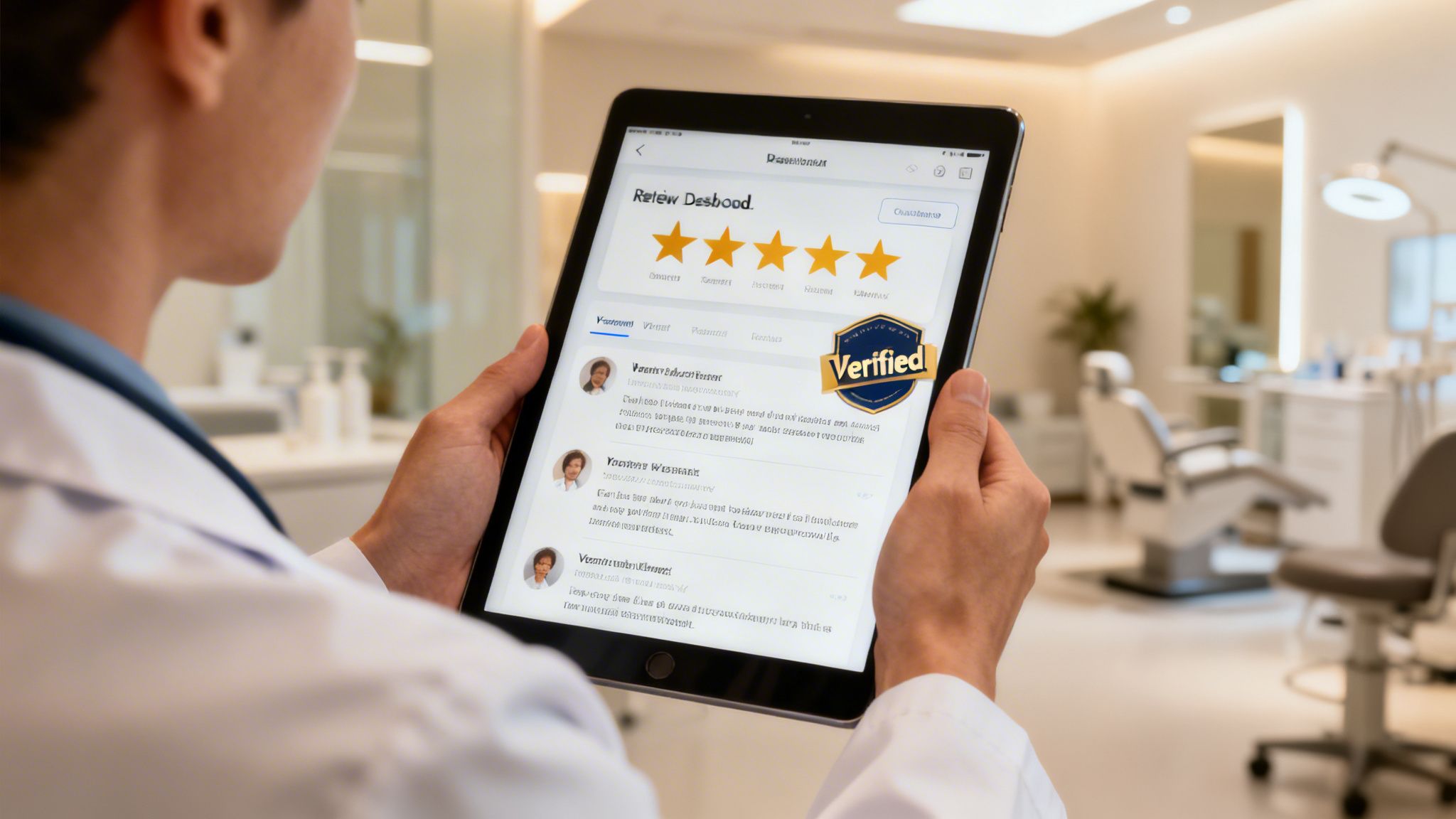
Think about it from a patient's perspective. When they're searching for a new doctor, what's the first thing they look for? Reviews. A steady stream of recent, positive feedback is the digital equivalent of a recommendation from a close friend. It provides the social proof they need to feel confident enough to book an appointment. Google understands this, which is why its algorithms are built to recognize and reward these very human trust signals.
A Smart System for Generating Patient Reviews
Crossing your fingers and hoping for good reviews is not a strategy. You need a proactive, organized system to encourage happy patients to share their experiences. The goal is to make it dead simple for them to leave feedback right when their positive experience is top of mind.
This can be as straightforward as an automated text or email that goes out a few hours after their visit, with a direct link to your Google Business Profile review page. No friction, no guesswork.
Here are a few practical ways to get this system running:
- Automate the Request: Use your practice management software to automatically send review requests after an appointment.
- Personalize the Message: A quick note that appears to come directly from the doctor or nurse practitioner they saw feels much more personal than a generic clinic-wide email.
- Give Them a Direct Path: Don't make patients search for you. Send them a single link that takes them straight to the review form on Google, Healthgrades, or Vitals.
Think of your online reputation as an active asset, not a passive one. When you treat patient reviews with the same care and attention you give to the in-office experience, you'll see a real difference in your online visibility.
The Art of Responding to Feedback
Responding to every single review—good or bad—is absolutely essential. It demonstrates that you’re listening, you value patient input, and you’re dedicated to providing the best possible care. For positive reviews, a simple and sincere "Thank you" goes a long way in reinforcing that patient's goodwill.
Negative reviews, on the other hand, require a more delicate touch. The key is to respond publicly with a calm, professional, and HIPAA-compliant message. Never get into specifics. Instead, acknowledge their concern and offer to take the conversation offline to resolve it. This shows prospective patients that you take feedback seriously and handle issues professionally. Integrating these workflows with modern technology solutions for healthcare can make managing this process far less of a headache.
Putting Your Hard-Earned Trust on Display
Once you've collected a bank of glowing reviews, don't let them sit idle on third-party sites. Put them to work on your own website.
You can create a dedicated testimonials page or, even better, embed a live feed of your 5-star Google reviews directly on your homepage. This acts as powerful, immediate social proof that builds credibility and keeps visitors on your site longer—another positive signal for search engines.
The data backs this up completely. Practices that integrate reputation management into their SEO strategy report seeing 75% more phone calls and a 110% growth in local visibility. Your reputation is the engine of your medical SEO.
Navigating HIPAA Compliance in Your SEO Strategy
In medicine, trust is everything. That trust doesn't just happen in the exam room; it extends to every interaction you have with a patient, including online. This is where SEO for a medical practice gets tricky. You have to walk a fine line between effective marketing and the ironclad rules of the Health Insurance Portability and Accountability Act (HIPAA).
Let's be clear: a HIPAA mistake isn't just a marketing blunder. It can bring devastating legal and financial penalties down on your practice.
The fundamental conflict is that great marketing often involves sharing success stories, while HIPAA is built to protect patient privacy at all costs. A single misstep, like posting a patient's photo on your website without the right kind of explicit, written consent, is a serious violation. Your entire digital presence has to be built on a foundation of compliance, from the code on your website to the content you publish.
Your Technical Foundation Must Be Bulletproof
HIPAA compliance starts with the nuts and bolts of your digital infrastructure. Your website is more than an online brochure—it’s a gateway for communication that might handle Protected Health Information (PHI), especially if you have contact forms, appointment schedulers, or patient portal access.
Securing that gateway is non-negotiable.
- SSL Certificates: An SSL certificate encrypts the data traveling between a patient's web browser and your site. It’s what turns "HTTP" into "HTTPS." Without it, any information submitted through a form is exposed. Google also heavily favors secure sites, so this is a must-do for both security and SEO.
- Secure Web Hosting: You can't just pick any hosting company. You need a provider that is explicitly HIPAA compliant and will sign a Business Associate Agreement (BAA). These hosts have the required security measures to protect the servers where any potential PHI is stored.
- Compliant Forms and Tools: Every tool on your site that collects information—contact forms, online schedulers, live chat widgets—must be HIPAA compliant. This ensures any PHI is encrypted and handled according to strict security protocols.
Getting the digital infrastructure right can feel overwhelming. You have to make sure every single piece of the puzzle, from your hosting to your email, meets strict compliance standards. This is where a holistic approach to medical practice IT support can be a lifesaver, helping you manage these complex requirements without the headache.
Sharing Patient Stories Without Breaking the Rules
Content is where most practices get into trouble. Testimonials and case studies are incredibly powerful for attracting new patients, but you have to handle them with extreme caution.
The golden rule is this: never, ever use a patient's information for marketing without their explicit, written authorization.
This isn't a checkbox on a standard intake form. It must be a separate, detailed consent form that clearly explains what information will be used, exactly where it will be published (e.g., website blog, Facebook page), and for how long.
Even with a signed form, your safest bet is to anonymize the details as much as possible.
- Testimonials: Instead of a full name and photo, consider using initials or a first name and a general location, like "David R. from Springfield." It's a much safer route, even with permission.
- Case Studies: The focus should always be on the clinical journey, not the patient's personal life. Detail the condition, the treatment you provided, and the fantastic outcome, all without revealing a single detail that could identify the person.
- Before-and-After Photos: This is high-stakes. These photos are considered PHI, period. You need an ironclad, specific consent form signed by the patient before one of these images ever sees the light of day online.
By making these technical and content safeguards a core part of your process, you can build a powerful digital presence that brings in new patients while honoring the privacy and trust they place in you.
Common Questions About SEO for Medical Practices
Even with a solid plan, jumping into SEO can feel overwhelming. Practice owners are already balancing patient care with the day-to-day of running a business, so it's only natural to have direct questions about what to expect, how much it costs, and when you'll actually see a return.
Let's cut through the noise and tackle the real-world questions we hear from practices every single day.
How Long Does It Realistically Take to See SEO Results?
This is always the first question, and the honest answer is you need to think in months, not weeks. SEO is a long-term investment in your practice's growth, not a light switch you can flip for instant traffic.
While you might see some early movement in local search rankings within the first 90 days, the kind of significant, practice-building results you're looking for typically take 6 to 12 months of consistent, focused effort.
Why the long runway? Because you're building real trust and authority, and that doesn't happen overnight. Google needs to see a sustained pattern of positive activity—fresh, high-quality content, a steady flow of new patient reviews, and quality links from other reputable local sources.
Think of it like a patient's treatment plan. You wouldn't expect a chronic condition to be fixed after one appointment. SEO works the same way; it requires a consistent, methodical approach over time to build lasting health for your online presence.
What’s a Realistic SEO Budget for a Medical Practice?
Costs can swing pretty dramatically depending on your market's competitiveness, your specific specialty, and how aggressive you want to be. A solo practice in a small town will have a very different budget than a multi-location surgical center in a major city.
Be very skeptical of any agency promising page-one rankings for a few hundred bucks a month. That's a huge red flag. Proper medical SEO is a professional service that requires deep expertise in content creation, technical optimization, local search strategy, and compliance.
Here’s a rough idea of what to expect:
- Foundational Investment: For a smaller practice just getting started, a monthly investment will likely begin in the low thousands.
- Competitive Markets: For practices in dense urban areas or for highly competitive specialties like plastic surgery or fertility, budgets can be significantly higher to keep pace with the competition.
The most important thing is to view this as an investment in a patient acquisition channel that you own. Unlike paid ads, which vanish the second you stop paying, good SEO builds a valuable, lasting asset for your practice.
Can My Staff Handle SEO In-House?
While it’s technically possible, it’s almost never practical. Effective SEO isn’t just one person's job; it's a combination of several highly specialized skills that most medical offices simply don't have on the payroll.
A successful campaign needs people who understand:
- Technical SEO: Managing site speed, security, and complex Schema markup.
- Content Strategy: Researching what patients are searching for and creating medically accurate, E-E-A-T compliant content.
- Local SEO: Optimizing your Google Business Profile, managing directory listings, and building local citations.
- Analytics: Digging into the data to track performance and make smart decisions.
Trying to juggle all of that while running a busy practice is a recipe for burnout and mediocre results. Partnering with an agency or consultant who lives and breathes healthcare marketing lets your team focus on what they do best: taking care of patients.
Do Different Specialties Need Different SEO Tactics?
Absolutely. While the fundamentals of local SEO and building authority apply to everyone, the smartest strategies are tailored to how patients search for specific services.
For instance, an aesthetic dermatology or med spa practice is incredibly visual. Their SEO efforts should lean heavily into:
- High-quality before-and-after photo galleries (with clear patient consent, of course).
- Video testimonials and clips of procedures being performed.
- Blog content and service pages that speak directly to aesthetic goals and concerns.
On the other hand, a primary care physician will likely get more traction by focusing on:
- Helpful blog posts that answer common health questions, like "when should I see a doctor for a persistent cough?"
- Heavy optimization for "doctor near me" and insurance-related searches.
- Building a strong review profile that highlights trust, compassion, and bedside manner.
The best strategy always begins with a deep dive into your ideal patient's specific journey.
Ragnar STACK delivers a vertically integrated technology ecosystem purpose-built for healthcare practices, eliminating the complexity of managing multiple vendors. Our platform unifies your IT, security, and operational workflows so you can focus on patient care. Discover a seamless solution at https://notes.rstack.io.
Share This Story, Choose Your Platform!
LISTEN NOW

CAPTIVATING READS

Our blog is packed with articles and stories based around lifestyle, business, design and wellbeing. Subscribe now to get all of our updated directly to your inbox every week.