
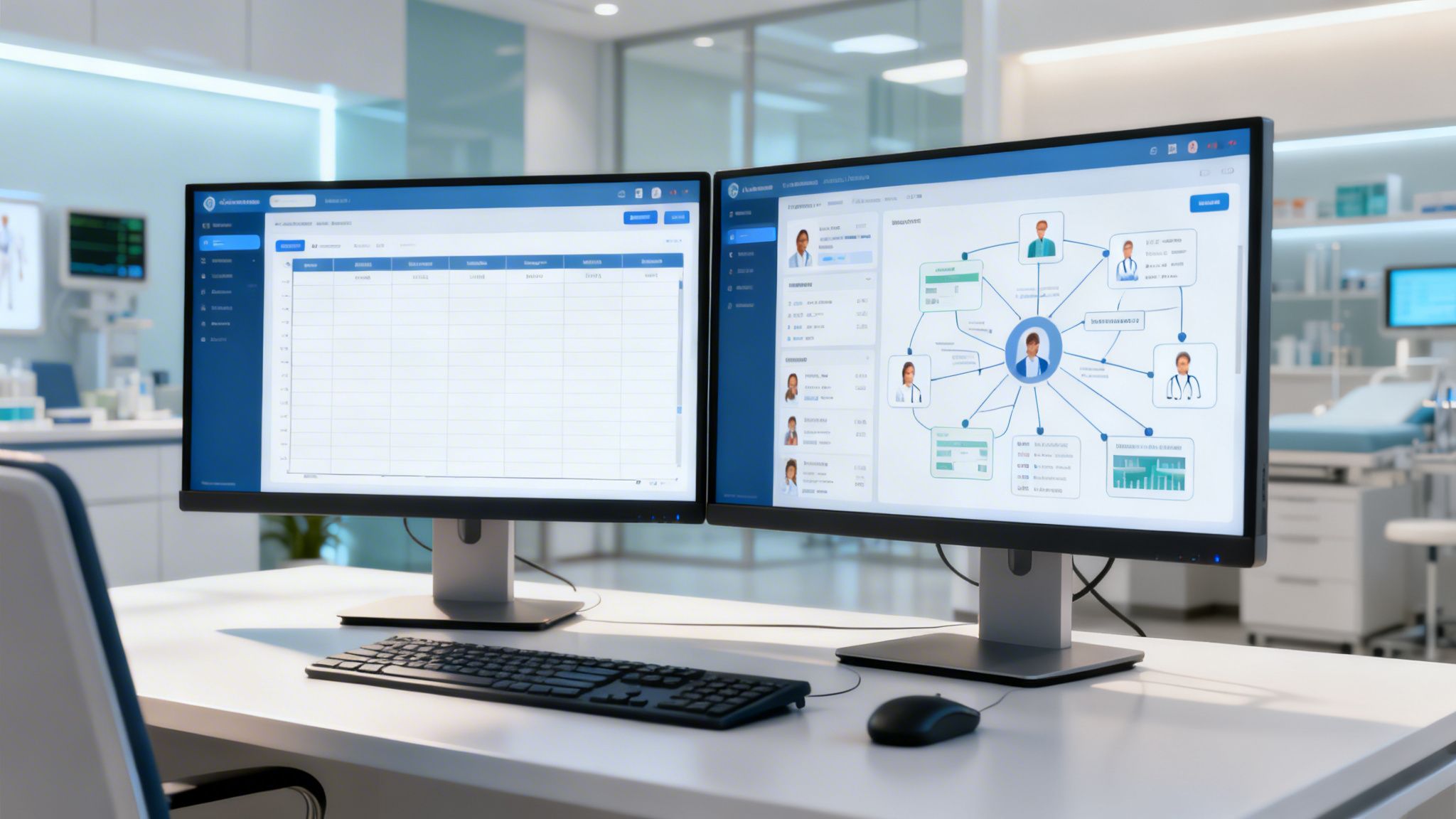
It's easy to get tangled up in the alphabet soup of healthcare technology, but the difference between an EMR and an EHR really boils down to one simple concept: scope. An Electronic Medical Record (EMR) is the digital equivalent of the old paper charts you'd find in a single doctor's office. An Electronic Health Record (EHR), on the other hand, is the full story—a complete health narrative that follows a patient across all their providers.
Think of it this way: an EMR is a single chapter of a patient's health journey, written by one practice. The EHR is the entire book.
EMR vs. EHR: Understanding the Core Differences
At first, EMR and EHR sound like they do the same thing. And in a way, they do—both are digital systems for storing patient information. I've heard countless professionals use the terms interchangeably, but knowing the real difference is crucial before you invest in a system for your practice. This isn't just about semantics; it's about defining how you manage and share patient data to deliver the best care.
An EMR is, at its heart, an internal tool. It’s fantastic for tracking a patient’s history, diagnoses, and treatments within your clinic. For a practice like a medspa, where a client's entire treatment history is usually contained within your four walls, a good EMR often has everything you need for things like billing and tracking treatment progress.
EHRs, however, are built for teamwork. They create a comprehensive, long-term health record that can be securely shared with other providers—think labs, specialists, other clinics, and hospitals. This ability to "talk" to other systems, known as interoperability, is the game-changer. It makes sure everyone involved in a patient's care is on the same page, which is absolutely essential for primary care, wellness clinics, or concierge practices where coordinated care isn't just a goal, it's a necessity.
The real sticking point between the two is data portability. EMRs are designed to keep digital records inside one office. EHRs are built to follow the patient wherever they go for care.
EMR vs. EHR At a Glance
To make this crystal clear, let's break down the key distinctions. This table gives a quick snapshot of how they differ in scope, how they share data, and what they're ultimately designed to do.
And if you want to go even deeper into the variations, you can explore the different types of EMR systems out there.

| Attribute | EMR (Electronic Medical Record) | EHR (Electronic Health Record) |
|---|---|---|
| Data Scope | Contains the medical and treatment history from a single practice. | A comprehensive record of a patient's overall health across providers. |
| Interoperability | Not designed for easy data sharing outside the practice. | Built to securely share information with labs, specialists, and hospitals. |
| Primary Goal | To digitize paper charts for diagnosis and treatment within one clinic. | To provide a holistic view of patient care and support coordinated treatment. |
| Patient Focus | A record of a patient's care at one specific location. | A patient-centric record that travels with them across their care journey. |
Ultimately, choosing between an EMR and an EHR depends entirely on how your practice operates and who you need to collaborate with to provide patient care.
How an EMR Functions Within Your Practice

Think of an Electronic Medical Record, or EMR, as the digital successor to the classic paper chart. It’s the operational core for an individual clinic, designed to capture, manage, and store patient information generated within your four walls. Essentially, it’s a sophisticated digital filing system built for one practice.
The main job of an EMR is to track the patient's journey and clinical data over time, but only from the perspective of your facility. It's incredibly effective for monitoring treatment responses, flagging patients due for preventative screenings, and ensuring consistent care during their visits with you. This makes it a fantastic tool for improving diagnostic precision and maintaining high care standards internally.
Core Functions of a Typical EMR
The real power of an EMR is its laser focus on the day-to-day operations of a single practice. For a clinic with a self-contained client history, like a medical spa, an EMR often has everything needed to run the business smoothly. Most systems are built around these key functions:
- Diagnosis and Treatment Tracking: Clinicians can log diagnoses, monitor how a patient's condition evolves, and make decisions based on a complete history of their past visits to your office.
- Workflow Optimization: From the moment a patient checks in until the final bill is sent, the system helps manage the entire visit, cutting down on administrative tasks and paperwork.
- Billing and Coding: A crucial feature, EMRs link clinical notes directly to the billing process, helping you generate accurate invoices and manage insurance claims efficiently.
This practice-centric design is what makes an EMR so valuable. But it’s also its greatest weakness. The fundamental difference between EMR and EHR systems comes down to scope—an EMR isn't built to share its data with other providers easily. This limitation created the information silos that have plagued healthcare for decades. While EMR adoption skyrocketed from under 1% before 1991 to nearly 87% today, true data interoperability remains a significant challenge. You can read more about the history and adoption of these systems on aptarro.com.
An EMR is the digital version of a patient's chart at one doctor's office. It holds the medical history created and maintained by a single provider, making it great for internal use but poorly suited for coordinated care across different specialists or hospitals.
The Limitation: Information Silos
The problem with an EMR becomes obvious the moment a patient needs care outside your practice. If you need to send records to a specialist, another clinic, or a hospital, you're often stuck printing out pages or faxing documents. This friction is a real barrier to coordinated care.
This siloed nature is a key part of understanding the difference between EMR and EHR. We explore this further in our guide to finding the best EMR for your private practice. Ultimately, this inability to easily share information gets in the way of the seamless, connected healthcare experience that patients now expect.
A Patient’s Complete Health Story, Captured in an EHR
If an EMR is a single chapter in a patient's health story, an Electronic Health Record (EHR) is the entire book. It’s a patient-centric system that pulls together their entire medical history from every single provider they see. We’re talking about data from their primary care doctor, the dermatologist, the lab that ran their bloodwork, and the hospital they visited last year.
The magic word here is interoperability. Unlike the closed-off nature of an EMR, an EHR is built to securely share information across different healthcare settings. This ensures a patient’s critical health data travels with them, creating a seamless, coordinated care experience. For practices like primary care, functional medicine, or concierge clinics, this isn't just a nice-to-have; it's the very foundation of how they operate.
More Than Just Clinical Notes: The 360-Degree View
An EHR goes far beyond just logging diagnoses and treatments. It’s designed to provide a complete picture of a patient's well-being, which helps providers shift from reactive care to proactive health management. Today's EHRs come equipped with tools that are essential for a modern, patient-focused practice:
- Integrated Patient Portals: These give patients a window into their own health, letting them see test results, check appointment schedules, and feel more involved in their care.
- Preventive Care Reminders: The system can automatically flag when someone is due for a screening or a follow-up, which is a game-changer for long-term health management.
- Secure Communication Tools: Built-in messaging allows patients and providers to connect easily, and it also lets different specialists on a care team collaborate without picking up the phone.
With these features, the patient record transforms from a static digital file into a living tool for achieving better health. The data backs this up, too. Practices using EHRs see 70% fewer medical errors and a 25% improvement in managing chronic diseases—critical for any wellness-oriented clinic. By giving physicians access to clinical decision support and saving them hours each week, EHRs directly elevate the quality and efficiency of care. For a deeper dive, check out this breakdown of electronic health record statistics.
An EHR is the entire book of a patient's health story, not just a single chapter. It collects and connects every piece of information from every provider, creating a single, shareable source of truth that follows the patient wherever they go.
At its core, the EMR vs. EHR distinction is about a fundamental shift in perspective—from a record that serves the practice to one that serves the patient. It’s this collaborative, big-picture approach that enables true continuity of care, making the EHR the undisputed standard for modern healthcare.
Choosing the Right System for Your Practice Type
Knowing the technical difference between an EMR and an EHR is the easy part. The real challenge is figuring out which one actually fits the way your practice works day-to-day. This isn't just a software decision; it's about choosing a tool that aligns with your business model, your patients' needs, and where you plan to be in five years.
The choice you make will ripple through every corner of your practice, from how you manage appointments to the quality of care you provide.
At its core, the logic is straightforward. If your practice operates as a self-contained unit, an EMR might suffice. But the moment you start coordinating care with other providers, labs, or hospitals, an EHR becomes essential.

As this flowchart shows, the more interconnected your care network is, the more critical an interoperable EHR is for keeping patients safe and healthy.
Medical Spas and Aesthetic Practices
For most medspas, the client relationship is managed almost entirely in-house. You handle the consultations, treatments, billing, and follow-ups. A focused EMR often seems like the obvious choice because it handles these core functions—charting, scheduling, and invoicing—perfectly well.
But think about this scenario: a client comes in for a laser treatment and casually mentions a new photosensitizing medication their dermatologist just prescribed. With an EHR connected to the wider health network, you could (with their permission) see that prescription and avoid a potentially harmful reaction. An EHR elevates your practice from just providing treatments to delivering truly holistic, safety-conscious care.
Primary Care and Wellness Clinics
If you're in primary care, there’s really no debate. You need an EHR. Your job is to be the quarterback of your patient's health journey, which means constant communication with specialists, labs, imaging centers, and hospitals. An EMR would be like trying to run the team with a disconnected playbook—it’s just not going to work.
An EHR is the central source of truth for a patient’s entire medical history. When you send a patient to a cardiologist, the specialist’s notes and new prescriptions flow right back into your system. This 360-degree view is non-negotiable for managing chronic diseases, staying on top of preventive care, and making sure everyone on the care team has the same up-to-date information.
For primary and wellness care, the ability to seamlessly share patient data isn't just a nice-to-have feature; it’s a fundamental requirement for modern medicine.
Specialty and Concierge Practices
Specialty and concierge practices are built on providing a superior, high-touch patient experience. Clients in this model expect proactive, deeply personalized care. That level of service is practically impossible without the powerful, connected capabilities of a modern EHR.
Imagine a concierge physician whose patient has an emergency while traveling. An EHR allows the doctor to securely send that patient’s complete medical history to an ER across the country, coordinate with local specialists, and ensure care is never interrupted. For a specialty clinic focused on outcomes, an EHR is crucial for tracking data across patient populations, integrating with advanced diagnostic tools, and even contributing to research.
Making the right choice here is critical. As you weigh your options, reviewing some of the best EMR systems for small practices can give you a solid foundation for your evaluation.
Navigating Interoperability, Security, and Compliance

The core difference between EMR and EHR systems goes right to their technical foundations, and that has huge implications for how you manage security and compliance. It all comes down to one key concept: interoperability. An EHR is built from the ground up to securely share data with other systems, which is how a patient’s health story can travel seamlessly from their primary care doctor to a specialist and then to a hospital.
An EMR, on the other hand, is essentially a closed loop. Its main security focus is protecting data "at rest" inside your practice's own network. Think of it as a digital file cabinet with a very strong lock.
An EHR has a much bigger job to do. It has to master security for data "in transit," which is a whole different ballgame. This requires serious encryption and tight access controls to keep patient information safe as it travels between different networks and providers. While any system you use must be HIPAA compliant, the interconnected nature of an EHR means the security measures have to be far more robust to prevent breaches during all that data exchange.
The Hidden Risks of a Patchwork System
A lot of practices end up trying to create their own EHR by stitching together different pieces of software: an EMR from one company, a billing platform from another, and a patient portal from a third. This patchwork approach might seem flexible, but it often opens up major security and compliance holes. Every new vendor you add is another potential weak link in the chain.
This setup makes your compliance work a nightmare. Instead of managing one set of security rules and one Business Associate Agreement (BAA), you're suddenly juggling the compliance standards of every single vendor in your stack. If just one of them has a security slip-up, it’s your practice's data—and your reputation—on the line.
A fragmented technology stack doesn’t just create operational headaches; it creates a patchwork of security vulnerabilities. Managing compliance across multiple vendors is a high-stakes task that consumes time and increases the likelihood of a costly data breach.
Unified Platforms and Simpler Compliance
This is where a vertically integrated platform really shines. By bringing all your practice management functions under one roof, it closes the security gaps that a multi-vendor setup creates. The security protocols are the same across every tool you use, from scheduling to billing, which creates a much tougher, more consistent defense.
A unified approach also makes staying on the right side of regulations much easier. You have a single point of contact for support and one clear audit trail for everything, which is a lifesaver if you ever face an audit. If secure patient communication is a priority, looking into a HIPAA compliant messaging platform is a smart move toward building a more secure practice.
Ultimately, choosing a unified system isn't just an IT decision. It’s a strategic choice to fortify your security, cut down on administrative hassle, and protect the future of your practice.
EMR vs. EHR? Let's Ask a Better Question.
The whole EMR vs. EHR debate often misses the forest for the trees. For modern practices, the real question isn't which acronym to pick. It’s about how to stop drowning in a sea of disconnected software.
Most clinics find themselves juggling 8-12 different vendor solutions. Each new tool, from scheduling to billing to patient portals, adds another layer of complexity, creating operational headaches and, frankly, significant security vulnerabilities.
This patchwork approach forces your practice to become an amateur IT integration firm. Instead of focusing on patient outcomes, your team is stuck managing a dozen different contracts, troubleshooting clunky integrations, and manually re-entering data between systems that refuse to talk to each other. The promise of digital efficiency gets buried under a mountain of busywork.
The Power of a Single, Unified Platform
It's time to move past the old comparisons and think in terms of a complete ecosystem. A unified platform isn't just an EHR with a few extra bells and whistles; it’s a complete operational overhaul. It brings every critical function—clinical records, billing, IT infrastructure, cybersecurity, and patient communication—under one roof.
This model is the antidote to vendor chaos. Imagine your team having one login, one system to learn, and one number to call for support. Ragnar STACK is built on this exact philosophy. It delivers all the powerful, shareable data of a top-tier EHR but also handles the foundational IT, security, and operational workflows that most systems ignore.
An integrated ecosystem treats your entire technology infrastructure as a single, cohesive asset, not a messy collection of parts. This is the only way to achieve real operational excellence without the security gaps that come from a multi-vendor setup.
When you partner with a single provider for your entire stack, you get a system where every component is built to work together securely from the ground up. You get one source of truth, one compliance framework, and one streamlined path to growth. It simplifies everything, letting you get back to what actually matters: your patients.
Common Questions About EMR vs. EHR
When you're trying to choose the right system for your practice, a lot of practical questions come up. Let's tackle some of the most frequent ones we hear from practice owners trying to make sense of the EMR and EHR landscape.
Can You Upgrade from an EMR to an EHR System?
Absolutely. In fact, it's a very common move for practices that are growing and need better ways to coordinate care with other providers. The switch involves moving all your patient data from the old EMR into the new EHR platform.
This data migration is the most critical part of the process. You have to plan it carefully to make sure nothing gets lost or corrupted. Working with a provider that offers a vertically integrated system can make this a lot smoother—they handle the entire migration and ensure everything just works together from day one.
Is an EHR More Expensive than an EMR?
On the surface, yes. An EHR system usually has a higher upfront cost because it does so much more, especially with connecting to other systems. But looking only at the initial price tag is a mistake.
You have to think about the total cost of ownership over time. An EHR often saves money in the long run by making your practice more efficient and helping to prevent expensive medical errors. Think about it: a cobbled-together system using multiple EMR-like tools brings a lot of hidden costs from managing different vendors and dealing with integration headaches. A single, unified EHR is a far more predictable and stable investment.
The real security challenge isn't just protecting data at rest; it's protecting data in motion. EMR security is about locking down data inside your four walls. EHR security is about protecting that same data as it travels between you and other authorized providers.
What Is the Main Security Difference Between EMR and EHR?
The biggest difference boils down to how data is shared. An EMR's security is relatively straightforward; its main job is to protect patient data stored on your practice's isolated network.
EHR security is a whole different ballgame. It has to protect Protected Health Information (PHI) while it's moving between different organizations—like from your clinic to a lab, or from a primary care doctor to a specialist. This demands much more robust security measures like strong encryption, strict access controls, and detailed audit trails to stay HIPAA compliant across the entire healthcare network.
Juggling a fragmented tech stack creates risks and wastes time. Ragnar STACK solves this by offering a single, vertically integrated ecosystem that covers everything from your EHR to cybersecurity. This lets you get back to focusing on what matters—patient care.
Discover a simpler, more secure way to run your practice at https://notes.rstack.io.
Share This Story, Choose Your Platform!
LISTEN NOW

CAPTIVATING READS

Our blog is packed with articles and stories based around lifestyle, business, design and wellbeing. Subscribe now to get all of our updated directly to your inbox every week.