
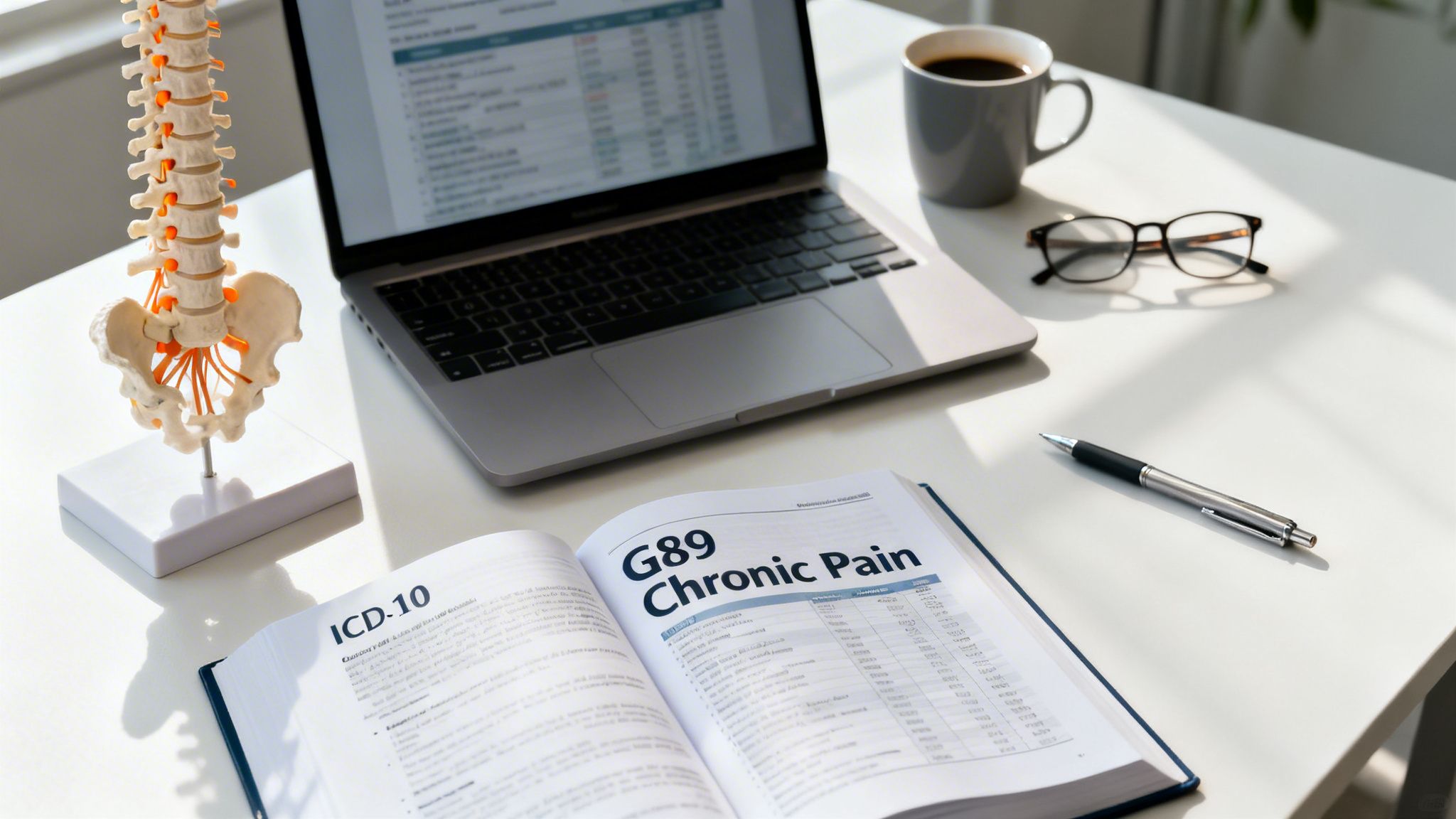
When you're dealing with chronic pain, the go-to chronic pain ICD 10 code is often G89.29, for "Other chronic pain." This falls under the broader G89 category, which is specifically for "Pain, not elsewhere classified." Think of these G89 codes as the essential tools for documenting and billing for any pain that's stuck around for more than three months, setting it apart from acute issues.

Quick Reference For Chronic Pain ICD 10 Codes
Getting the coding right for chronic pain isn't just about paperwork; it's critical for getting properly reimbursed, proving medical necessity, and making sure your patients receive seamless care. The G89 series gives us the foundation for classifying pain that can't be pinned to another specific disease during a patient visit. This section is designed to be your quick guide to the most common codes, helping you and your team find the right one without the guesswork.
Let's not forget how widespread this is. Chronic pain is a massive global health problem, with new cases popping up at a rate of 52.4 per 1,000 persons annually. To put that in perspective, that's higher than the rate for new diagnoses of diabetes (7.1 per 1,000) and even hypertension (45.3 per 1,000). You can dig deeper into these chronic pain statistics on TheraPlatform. This reality just underscores why precise coding is so important.
Top Chronic Pain ICD 10 Codes Quick Lookup
To make things easier, here is a quick-lookup table covering the G89 codes you'll likely use most often. We've included the code, its official descriptor, and a clear example of when to use it. Using this can help you steer clear of vague codes that often result in claim denials.
| ICD-10 Code | Official Descriptor | Primary Use Case |
|---|---|---|
| G89.21 | Chronic pain due to trauma | For persistent pain lasting over three months following a specific physical injury, such as a car accident or fall. |
| G89.22 | Chronic post-thoracotomy pain | Specifically for long-term pain at the site of a chest wall incision after thoracic surgery. |
| G89.28 | Other chronic postprocedural pain | Used for chronic pain resulting from a surgical or medical procedure other than a thoracotomy. |
| G89.29 | Other chronic pain | A general code for chronic pain when the cause is unspecified or does not fit into a more precise category. |
| G89.3 | Neoplasm related pain (acute) (chronic) | Reserved for pain directly associated with a cancerous tumor, whether acute or chronic in nature. |
| G89.4 | Chronic pain syndrome | For complex cases where chronic pain is accompanied by significant psychosocial dysfunction, such as depression. |
This table should serve as a solid starting point for everyday coding, ensuring your documentation accurately reflects the patient's condition.
Understanding the G89 Category for Pain Management
When it comes to chronic pain ICD-10 coding, the G89 category—"Pain, not elsewhere classified"—is a cornerstone. It gives us a specific place to classify pain when the pain itself is the star of the show, not just a symptom of some other condition we're treating. Getting this distinction right is absolutely critical for proper billing and proving that the pain management services you're providing are medically necessary.
Think of it this way: you'll reach for a G89 code when a patient's pain can't be pinned down to a specific underlying disease during that particular visit, or when managing their pain is the primary reason they're seeing you. The category is designed to be broad enough to handle all sorts of clinical situations where pain is the main problem. It’s also broken down into subcategories that help you differentiate between acute and chronic pain, which is a fundamental split in the world of pain coding.
The official ICD-10 guidelines draw a clear line in the sand based on time. We classify acute pain as something that lasts less than three months and is usually tied to a recent injury or illness. Chronic pain, on the other hand, is defined as any pain that sticks around for longer than three months, often long after the initial injury should have healed.
Key G89 Subcategories Explained
To code accurately, you have to get comfortable with the main subcategories inside G89. Each one tells a different story about the pain's origin or type. Let's walk through the most common codes you'll encounter in this series.
G89.0 Central Pain Syndrome
This code is specifically for a neurological condition triggered by damage to the central nervous system (CNS). This isn't just general pain; it's a constant, often debilitating pain sensation caused by a stroke, multiple sclerosis, or a spinal cord injury. Use this code only when you have a confirmed CNS pathology as the root cause.G89.2 Chronic Pain, Not Elsewhere Classified
You’ll probably use this one a lot. It’s the go-to code for documenting persistent pain when the source isn’t specified or doesn't neatly fit into another box like trauma-related or post-surgical pain. It’s essentially the default choice for ongoing pain where a separate, clear-cut diagnosis isn't driving the symptoms.G89.3 Neoplasm Related Pain (Acute or Chronic)
This code is reserved for pain that is a direct result of a cancerous tumor or the side effects of cancer treatment. It covers both acute and chronic presentations but must be linked to a documented malignancy. A classic example would be a patient with bone cancer who has persistent pain right at the tumor site—that’s a clear-cut case for G89.3.
Coding Best Practice: Here’s a crucial rule of thumb: avoid using a general G89 code if a more specific, site-based pain code (like M54.5 for low back pain) tells the whole story and is the focus of your treatment. The G89 series really shines when the pain is widespread, the cause is murky, or the primary goal of the visit is simply to manage the pain itself.
A Detailed Guide to G89.2 Chronic Pain Subcodes
Think of the chronic pain ICD-10 code G89.2 as a starting point. While it broadly classifies chronic pain, it's the subcodes that give your documentation the muscle it needs for accurate billing and clear clinical storytelling. Simply using G89.2 often isn't enough for payers—they need more detail. By digging into G89.21, G89.22, G89.28, and G89.29, you can paint a much clearer picture of your patient's condition.
This level of detail is about more than just checking a box; it's about explaining the origin of the pain. Knowing whether the pain stems from an old injury or a past surgery is fundamental to justifying medical necessity and shaping the entire care plan.

G89.21 Chronic Pain Due to Trauma
This code is specifically for persistent pain that is the direct result of a prior physical injury. To use it, you need a clear causal link to a traumatic event, and the pain must have lasted for more than three months.
- Official Descriptor: Chronic pain due to trauma
- When to Use It: Reach for this code when your notes confirm the patient's ongoing pain started after an accident, a fall, or another distinct physical trauma.
- Clinical Example: A patient comes in with persistent right knee pain six months after a car accident that caused a tibial fracture. The fracture itself has healed, but the pain lingers. The primary diagnosis here would be G89.21, supported by a secondary sequela code for the history of the fracture.
A Quick Note on Sequencing: Be careful not to use G89.21 if the pain is just a normal part of the healing process for an acute injury. This code is reserved for situations where the pain becomes a separate, chronic problem long after the initial trauma has technically resolved.
G89.22 and G89.28 Postprocedural Pain
These two codes help you specify chronic pain that develops after a medical procedure. The key difference between them is the type of surgery involved, which makes precision critical.
G89.22 Chronic Post-thoracotomy Pain
This is a very specific code. It’s used exclusively for pain that persists at the incision site after a thoracotomy—a surgical incision into the chest wall.
G89.28 Other Chronic Postprocedural Pain
This code is much broader. It's your go-to for chronic pain that follows any surgical or medical procedure other than a thoracotomy.
- Clinical Example for G89.28: Imagine a patient who has been dealing with debilitating abdominal wall pain for over a year after a hernia repair. The pain is localized right at the surgical site. This is a textbook case for using G89.28.
G89.29 Other Chronic Pain
What happens when the chronic pain isn't tied to trauma, a procedure, or a neoplasm? That's where G89.29 comes in. It serves as the code for unspecified or idiopathic chronic pain that doesn’t fit neatly into the other categories.
This is one of the most common chronic pain ICD-10 codes you'll encounter. However, it's best practice to use it only after you've ruled out more specific causes.
- When to Use It: This is the right code for generalized chronic pain conditions or when the pain's origin remains unknown despite a thorough workup.
- Clinical Example: A 55-year-old patient reports widespread body aches and persistent fatigue that have been present for two years without any clear trigger. After investigation, the documentation would support G89.29 to accurately capture the chronic nature of their symptoms.
Coding High-Impact Chronic Pain and Related Conditions
Not all chronic pain is the same, and the ICD-10 system gives us the tools to capture just how much a patient's condition affects their life. When pain severely limits a person's ability to work, socialize, or simply get through the day, we classify it as high-impact chronic pain (HICP). Getting this distinction down in your notes is absolutely critical for justifying more intensive treatment plans and getting paid for them.
We're talking about something far more debilitating than standard chronic pain. HICP is a serious condition that affects a huge number of people. In fact, it impacts 6.9% of U.S. adults—that's 17.1 million people in 2021—who find their lives are profoundly restricted by pain. For a deeper dive, you can check out the complete 2023 CDC report on chronic pain trends from 2019-2021.
Capturing Functional Impact in Documentation
To properly code for HICP, your documentation has to paint a clear picture of how the pain is impacting the patient's Activities of Daily Living (ADLs). Vague notes just won't cut it. You need to get specific.
- Work and School: Is the patient unable to keep a job? Have they had to cut back their hours? Are they struggling to focus on basic tasks? Write it down.
- Social and Family Life: Note if they've withdrawn from social events, can't participate in family activities, or are unable to keep up with household chores.
- Self-Care: Detail any difficulties with personal grooming, getting dressed, or moving around that require them to have help.
This level of detail provides the clinical evidence needed to support a chronic pain ICD-10 code from the G89 series. It also tells a clear, compelling story to payers about the patient's condition.
When you explicitly state that the pain is "high-impact" and back it up with concrete examples of functional decline, you build an airtight record. This validates the medical necessity for things like comprehensive pain management, physical therapy, and other vital interventions.
Coding for Common Comorbidities
Patients struggling with HICP rarely come in with just one problem. They often have related conditions that you also need to code to capture the full scope of their illness. Two of the most frequent co-occurring conditions are depression and sleep disturbances, both of which complicate treatment and need their own diagnostic focus.
Depression
- F32 (Major depressive disorder, single episode)
- F33 (Major depressive disorder, recurrent)
When you document depression alongside chronic pain, you're creating a more complete clinical profile. This can also help support a diagnosis of G89.4 (Chronic pain syndrome) if there's significant psychosocial dysfunction involved.
Sleep Disturbances
- G47 (Sleep disorders)
Use these codes when the pain is directly preventing your patient from getting restorative sleep—a common and exhausting part of living with HICP.
Sequencing Rules for Complex Cases
How you order your codes is just as important as which codes you choose. Proper sequencing is a must for compliance and accurate billing. The primary diagnosis—the code you list first—should always be the main reason for the encounter.
- Pain Management is the Focus: If the visit is primarily to manage the patient's chronic pain, the G89 code goes first. The underlying condition or any comorbidities are listed as secondary diagnoses.
- Underlying Condition is the Focus: If the visit is to manage the condition causing the pain (like rheumatoid arthritis), that specific diagnosis code is listed first. The appropriate G89 code then follows.
Getting these sequencing rules right is a major step toward optimizing your billing. To give your practice's financial health another boost, take a look at our guide on how to verify insurance coverage quickly and effectively.
G89 vs. Site-Specific Pain Codes: Making the Right Choice
One of the most common crossroads in chronic pain coding is deciding whether to use a general G89 code or a code that points to a specific anatomical location. While a chronic pain ICD 10 code like G89.29 is perfectly valid for generalized pain, payers are definitely pushing for greater specificity. The takeaway is simple: if the pain can be pinned to a specific part of the body, you should always lead with the site-specific code.
Think of it this way: a patient presenting with persistent low back pain is best coded with M54.5 (Low back pain), not a G89 code. Why? Because M54.5 tells a much clearer story about the patient's complaint. Using a general G89 code in this situation might signal to a payer that the primary source of the pain hasn't been identified, which could easily trigger a claim review or even a denial.
When G89 Codes Are The Right Call
So, what's the proper place for the G89 series? These codes are indispensable when the pain itself is the main event of the encounter. They are the go-to choice in a few key scenarios:
- Generalized Pain: The patient experiences widespread pain that isn’t isolated to one specific area.
- Central Pain Syndromes: This is for conditions like G89.0, where the pain originates from a central nervous system issue rather than a peripheral site.
- Undetermined Cause: A full workup has been done, but a definitive underlying cause or a single pain generator still hasn't been found.
- Pain Management Focus: The visit's primary goal is to manage the chronic pain, even if you know the underlying condition.
The fundamental rule is to code the diagnosis or symptom that is the chief reason for the visit. If a patient is there specifically to manage their diagnosed fibromyalgia and its associated chronic pain, a G89 code is the correct primary diagnosis. For more strategies on managing the financial side of these complex cases, our guide on improving your revenue cycle service center has some great advice.
G89 Codes vs Site-Specific Pain Codes Comparison
Choosing correctly always comes down to the clinical context of the visit. To make this clearer, I've put together a table outlining a few common situations to help you see the logic behind which code to use as the primary diagnosis.
| Clinical Scenario | Appropriate G89 Code | Appropriate Site-Specific Code | Coding Guideline |
|---|---|---|---|
| Chronic neck pain after a fall six months ago, with treatment focused on the neck. | G89.21 (Secondary) | M54.2 (Cervicalgia) | The site-specific code M54.2 is primary because the encounter is focused on a specific anatomical location. The G89 code can be used secondarily to add context about the traumatic origin. |
| Widespread body aches for over a year with no clear origin. | G89.29 | N/A | Since the pain is generalized and lacks a specific identified cause or location, G89.29 is the most accurate primary diagnosis. |
| Persistent pain directly at a tumor site in a patient with bone cancer. | G89.3 | Relevant Neoplasm Code (e.g., C79.51) | Here, G89.3 is listed first as the reason for the encounter is managing neoplasm-related pain. The code for the cancer itself is listed secondarily. |
| Chronic shoulder pain due to diagnosed rotator cuff tendinitis. | N/A | M75.1 (Rotator cuff tear or rupture, not specified as traumatic) | A definitive diagnosis exists that explains the site-specific pain. The G89 series is not necessary here as it would be redundant. |
Ultimately, this comparison highlights the importance of documentation that clearly justifies your code selection. Accurate coding not only ensures proper reimbursement but also contributes to a more precise and valuable patient health record.
Improving Documentation to Support Chronic Pain Codes
Accurate coding for chronic pain isn’t just about picking a code from a list; it’s a direct result of strong, detailed clinical documentation. Time and again, we see claims denied because of vague notes that simply state "chronic pain." To properly justify a chronic pain ICD-10 code and prove medical necessity, your records have to paint a complete picture of the patient's condition for anyone who might review it.
This means getting granular. Payers are looking for clear evidence that connects the patient's symptoms to their functional limitations and validates your treatment plan. Think of your documentation as the story that supports your coding choices—it’s what protects your practice during an audit and secures appropriate reimbursement for the complex care you provide.
This decision tree illustrates the first and most critical question in pain coding: is the encounter focused on pain management itself, or is it about the specific location of the pain?

As the flowchart shows, when the primary goal of the visit is managing the pain, a G89 code is usually the right choice. Otherwise, you should prioritize a code that specifies the anatomical site of the pain.
Key Documentation Elements to Include
To build a record that can withstand scrutiny, every patient note needs to include specific, objective details. A structured approach ensures any auditor or payer can quickly grasp the full clinical context.
- Onset and Duration: Always state when the pain started and confirm it has lasted for more than three months. This explicitly meets the clinical definition of chronic.
- Location and Quality: Be precise. Instead of "leg pain," write "right anterolateral thigh." Describe the character of the pain using patient-reported terms like "burning," "aching," or "sharp."
- Severity and Intensity: Use a consistent, standardized pain scale (like the 0-10 Numerical Rating Scale) to quantify the pain's severity, both at rest and with activity.
- Functional Impact: This is absolutely critical. Document exactly how the pain interferes with the patient's Activities of Daily Living (ADLs). For example, "Patient reports difficulty standing for more than 10 minutes, which prevents them from cooking their own meals."
Documentation Best Practice: Whenever possible, directly link the chronic pain to an underlying diagnosis. A simple statement like, "Chronic low back pain secondary to lumbar degenerative disc disease," creates the causal relationship that payers require.
Linking Pain to Underlying Conditions
Drawing a clear line between the pain and its root cause is a fundamental documentation requirement. Your EHR notes must explicitly connect the G89 code to the primary condition that's causing the symptoms. For example, a note might read, "The patient's chronic pain (G89.29) significantly impacts their ability to sleep and is directly related to their fibromyalgia (M79.7)."
This isn't just about good clinical practice; it’s a matter of compliance and accurate reporting. As you document these sensitive details, protecting that patient data is also paramount. Adopting a fully HIPAA-compliant messaging platform is a crucial operational step for ensuring security in any modern practice.
Making Chronic Pain Coding Work in Your Practice
Getting chronic pain coding right starts with setting up your EHR to guide clinicians toward the most accurate codes. Think of it as building guardrails. When you create templates that prompt for specifics like pain duration, severity, and any related conditions, you ensure the documentation ticks all the boxes for the G89 code series from the get-go.
These aren't just for compliance; they make life easier for your providers. Well-designed, intuitive prompts take the guesswork out of the encounter. For example, having automated fields for pain descriptors or linking underlying diagnoses directly to the chronic pain code helps keep the coding perfectly aligned with the clinical notes.
Smart EHR Setups
- Mandatory Fields: Make the "pain duration" field mandatory. If it's over three months, it helps justify the chronic pain diagnosis right away.
- Dropdown Menus: Instead of having providers search for codes, build in dropdowns for the most common G89 subcodes. This makes it easy to select G89.21, G89.22, G89.28, or G89.29 based on the patient's situation.
- Conditional Logic: Use smart logic to suggest site-specific codes when a particular diagnosis is entered. This steers clinicians away from just using a catch-all code and toward greater specificity.
Of course, even with a great setup, you need to check your work. Regular internal audits are your best friend here. They help you catch inconsistencies before a claim ever goes out the door, highlighting where your team might need more training and allowing you to run targeted workshops for both physicians and coders.
A billing manager at a multi-specialty clinic once told me, “A structured audit process can reduce coding errors by up to 25% in just three months.” That’s a powerful testament to being proactive.
A Practical Audit and Training Cycle
- Monthly Chart Reviews: Schedule time each month to review a sample of charts, focusing specifically on how chronic pain codes were used.
- Share What You Find: Collect the data on error rates, but don't just keep it in a spreadsheet. Summarize the key findings and discuss them in your team huddles.
- Targeted Training: Use the audit results to create focused training sessions and update your internal EHR guides. This closes the loop and prevents the same mistakes from happening again.
The shift from ICD-10 to ICD-11 really highlighted how much room for improvement there was. Research shows that with ICD-10, only 43.0% of chronic pain diagnoses were coded correctly. That number jumped to 63.2% with the improved structure of ICD-11. It's especially telling that ICD-10 missed the mark on 27.2% of secondary pain cases, while it was much more successful with primary pain conditions at 70.8% accuracy. You can read the full study on these coding accuracy improvements to see the data for yourself.
For more on integrating these kinds of improvements, check out our guide on enhancing healthcare systems with Ragnar STACK.
| Workflow Stage | Common Errors | How to Fix It & The Result |
|---|---|---|
| Clinician Documentation | Missing qualifiers for G89 codes | Built-in prompts improve specificity. |
| Billing Review | Unmapped or incorrect codes | Audits can reduce denials by 18%. |
| Claim Submission | Incomplete code sequencing | Automated checks enforce the proper order. |
Nailing down these stages does more than just ensure compliance; it speeds up your claim turnaround and directly impacts revenue. Many practices that have implemented these workflows report a 30% reduction in denials within the first six months.
Accurate workflows are the backbone of compliant coding and frictionless claims.
By combining smart EHR templates, consistent audits, and ongoing staff training, you create a solid, repeatable process. This integrated approach ensures that from the moment the patient is seen to the moment you're reimbursed, your chronic pain codes are applied correctly and consistently. It’s the most reliable way to optimize your coding quality.
Common Questions About Coding for Chronic Pain
Even seasoned coders can run into tricky situations with the chronic pain ICD-10 codes. Let's tackle some of the most common questions that come up in clinical practice to help you code with more confidence and precision.
How Do You Code Chronic Pain When the Cause is a Mystery?
When a patient's chronic pain doesn't have a clear, established underlying diagnosis, the G89 series is exactly what you need. The go-to code in these cases is G89.29 (Other chronic pain).
Just be sure your documentation backs it up. The clinical notes need to confirm the pain has lasted longer than three months and describe the steps taken to find a root cause. The golden rule is always to code to the highest level of specificity you can, based on what you know from that patient encounter.
What’s the Real Difference Between G89.29 and G89.4?
It's easy to get these two mixed up, but they represent very different clinical scenarios. Getting this right is crucial for accurately portraying the patient's condition.
- G89.29 (Other chronic pain): Think of this as the code for when chronic pain is the main event, but its origin is unknown or doesn't fit into a more specific bucket. It’s a general, yet appropriate, code for persistent pain.
- G89.4 (Chronic pain syndrome): This is a much heavier diagnosis. You should only use this code when the chronic pain is tangled up with significant psychosocial dysfunction. We're talking about conditions like depression, severe anxiety, social withdrawal, or major functional impairments that are a direct result of the pain.
To use G89.4, your documentation absolutely must refer to the "syndrome" and detail the psychosocial elements involved. A patient having both chronic pain and depression isn't automatically a syndrome; the two must be clinically interwoven.
Can You Bill a G89 Code Alongside an Acute Injury Code?
Typically, no. You wouldn't assign a G89 chronic pain code if the pain is directly and exclusively from a fresh, acute injury that's still healing. That’s just acute pain, and it's coded differently.
But there are exceptions. Imagine a patient with a known chronic condition like fibromyalgia who then sprains their ankle. In that case, you would absolutely code for both. The key is that your documentation has to clearly separate the new, acute pain from the ongoing, pre-existing chronic pain.
When Does a G89 Code Take the Top Spot as the Primary Diagnosis?
How you sequence your codes tells the story of the patient's visit, so getting it right matters. A chronic pain ICD-10 code from the G89 series should be listed first when the main reason for the appointment is the chronic pain itself.
For example, a patient has chronic pain from an old, fully healed injury (coded with G89.21). If they come in specifically to discuss new pain management strategies, get a medication refill for their pain, or receive a therapeutic injection, G89.21 becomes the primary diagnosis. The original injury is still relevant, but you’d list it as a secondary diagnosis because it wasn’t the focus of this visit.
Ragnar STACK delivers a vertically integrated technology ecosystem purpose-built for healthcare practices, eliminating the complexity of managing multiple vendors. By unifying IT, security, and operational workflows, we help you reduce overhead and improve data flow across your entire practice. Explore the integrated solution.
Share This Story, Choose Your Platform!
LISTEN NOW

CAPTIVATING READS

Our blog is packed with articles and stories based around lifestyle, business, design and wellbeing. Subscribe now to get all of our updated directly to your inbox every week.