
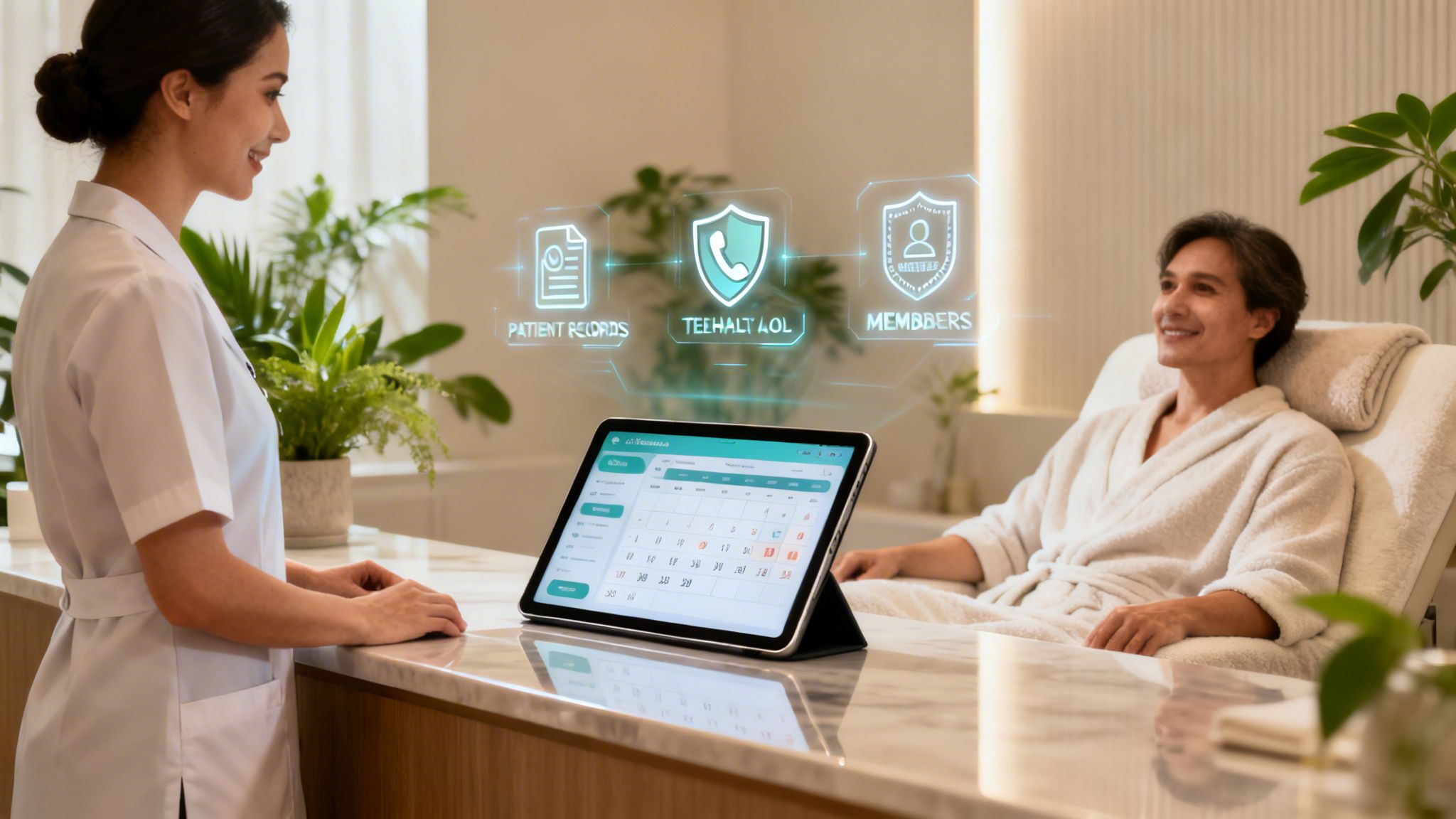
Think of the best practice manager you've ever met—the one who works 24/7, never makes a mistake, and seems to anticipate your every need. That’s what a modern spa management software platform feels like in a healthcare setting. It’s far more than a booking tool; it’s the operational nervous system for your entire medical spa.
What Is Medical Spa Management Software, Really?

In a clinical practice, this software does so much more than just schedule appointments. You can stop thinking of it as a digital receptionist's calendar and start seeing it for what it is: an air traffic control system for your entire operation. It's a platform specifically designed to manage the delicate dance between patient care, administrative tasks, and strict regulatory compliance.
For practices offering specialized services like IV therapy, aesthetics, or functional medicine, this kind of system is the engine for growth and efficiency. It handles everything from complex multi-practitioner schedules and secure patient records to HIPAA-compliant billing, seamlessly connecting your clinical excellence with a five-star patient experience.
From Manual Chaos to Digital Clarity
Not long ago, clinic managers were forced to juggle a dozen different tools. A paper calendar for appointments, overflowing filing cabinets for patient charts, one system for billing, and a totally separate one for marketing emails. This patchwork approach created constant friction, opened the door for errors, and made it nearly impossible to get a complete picture of a patient's journey.
Today’s integrated spa management software brings all these functions together under one roof. This shift delivers some pretty profound benefits for any healthcare-focused spa:
- A Single Source of Truth: You can track every patient interaction in one secure profile—from the initial booking and consent forms to treatment notes and follow-up messages.
- Smarter Operations: Automate the repetitive stuff. Appointment reminders, recurring membership billing, and inventory tracking can all run in the background, freeing up your team to focus on what they do best: patient care.
- Decisions Backed by Data: Instantly see what's working and what isn't. Get a clear view of provider productivity, which services are most popular, and what your patient retention rates look like.
This isn't just about making things easier; it's a strategic move to build a more resilient and profitable practice. It’s no surprise that the global spa management software market is predicted to jump from USD 0.48 billion in 2025 to USD 1.99 billion by 2034. That explosive growth is a direct result of practices ditching outdated manual processes for powerful, all-in-one digital solutions. You can see more on this trend over at Business Research Insights.
More Than a Simple Booking Tool
It's absolutely critical to understand the difference between generic salon software and a platform built for a medical environment. While both might handle bookings, software designed for healthcare integrates essential features like electronic medical records (EMR) and must adhere to strict HIPAA guidelines.
For a deeper look, check out our guide on what practice management software is and why it’s a different beast entirely. This clinical focus ensures your practice not only runs like a well-oiled machine but also maintains the highest standards of patient data security. That’s how you build unbreakable trust.
Modern Practice Challenges vs Software Solutions
Running a medical spa or wellness clinic today means facing a unique set of challenges that older, disconnected systems just can't handle. Below is a breakdown of common pain points and how a truly integrated software platform provides the solution.
| Operational Challenge | How Spa Management Software Solves It | Impact on the Practice |
|---|---|---|
| Double Bookings & Scheduling Errors | Provides a centralized, real-time calendar that syncs across all devices and practitioners, preventing conflicts. | Reduces no-shows, minimizes staff frustration, and ensures a smooth patient flow throughout the day. |
| Incomplete or Inaccurate Patient Records | Integrates Electronic Medical Records (EMR) with appointment history, consent forms, and treatment notes in a single profile. | Enhances quality of care, improves practitioner decision-making, and simplifies compliance audits. |
| HIPAA Compliance & Data Security Risks | Built with end-to-end encryption, secure patient portals, and role-based access controls to protect sensitive health information. | Drastically reduces the risk of data breaches, builds patient trust, and avoids costly regulatory fines. |
| Manual & Repetitive Administrative Work | Automates appointment reminders, billing cycles for memberships, and follow-up communications. | Frees up staff time by up to 40%, allowing them to focus on revenue-generating activities and patient experience. |
| Lack of Business Performance Insight | Offers built-in analytics dashboards to track KPIs like provider productivity, service revenue, and patient retention. | Empowers owners with actionable data to make smarter decisions about marketing, staffing, and service offerings. |
As you can see, the right software doesn't just fix one problem—it creates a positive ripple effect across your entire operation, turning daily frustrations into opportunities for growth and efficiency.
What Are the Real "Must-Have" Features for a Medspa Platform?

Forget the marketing buzzwords and shiny demos for a moment. When you get down to it, a truly effective medspa platform rests on a handful of non-negotiable features. These aren’t just nice-to-haves; they are the engine that keeps a modern medical spa running smoothly, compliantly, and profitably.
Think of them as the four foundational pillars holding up your entire practice. When they work together, your scheduling feeds into your patient records, which then makes billing and membership management a breeze. If one is weak, you'll spend more time fighting administrative fires than focusing on what really matters: your patients.
Smart, Resource-Aware Scheduling
The first pillar is intelligent scheduling. This is so much more than a digital calendar. In a medical setting, booking an appointment is a logistical puzzle. You’re not just holding a time slot—you're coordinating people, places, and expensive equipment all at once.
Let's say a patient books a laser hair removal session. A smart system instantly checks a few things:
- Provider Availability: Is a certified technician actually free?
- Room Allocation: Is the right treatment room, with the proper setup, available?
- Equipment Reservation: Is that specific laser machine—the one everyone needs to use—already booked?
This kind of multi-resource coordination is what prevents double-bookings, costly downtime, and frustrated staff. It’s a game-changer. Cloud-based platforms have been shown to boost operational efficiency by around 35% as clinics automate these tasks. For spas specifically, advanced scheduling features drive a massive 45% of user demand, according to some industry reports.
Integrated Patient Records and Clinical Charting
Next up, your system has to be the single source of truth for every patient. Generic salon software might track appointments, but a true medical-grade platform provides an Integrated Patient Record (EMR/EHR). This is where the "medical" part of "medspa" really comes into play.
Everything—and I mean everything—related to a patient's clinical journey lives in one secure, unified profile. If you want to dive deeper, we have an article explaining the difference between EMR and practice management.
A patient’s file should tell a complete story, not feel like a collection of scattered notes. It needs to hold signed consent forms, before-and-after photos, detailed SOAP notes, and follow-up plans, all locked down in a HIPAA-compliant environment.
Membership and Package Management
Recurring revenue is the key to a healthy, sustainable practice. That brings us to our third pillar: membership and package management. Trying to track who's on what plan, how many sessions they have left, and when their next payment is due is a nightmare to do manually. It’s also where costly mistakes happen.
A solid software platform automates this whole headache. It can handle recurring billing on its own, keep tabs on how many treatments in a package have been used, and automatically apply the right discounts at checkout. This doesn't just clean up your accounting and stabilize cash flow; it makes the entire experience feel effortless and professional for your clients.
Unified Billing and Point of Sale (POS)
Finally, all of this needs to tie together at the point of sale. A unified billing and POS system is the fourth pillar, connecting the clinical side of your practice directly to the financial side.
When a treatment is finished, the system already knows what was done, which provider did it, and what the correct charge is—including any membership perks. This integration makes checkout fast, cuts down on billing errors, and lets you handle both service payments and retail sales in one place. It gives you a crystal-clear, real-time picture of your practice's financial health by linking every appointment directly to the revenue it generates.
How Advanced Capabilities Drive Growth and Patient Loyalty

While the core features keep your clinic's doors open day-to-day, it’s the advanced capabilities that truly set your practice apart. These are the tools that shift your business from just running to actually thriving. They move beyond simple administration to become powerful engines for revenue and patient loyalty.
Think of it this way: core features are like the engine and wheels of a car—they get you where you need to go. Advanced features are the GPS, climate control, and driver-assist systems. They make the journey faster, more comfortable, and a whole lot smarter.
Automated Marketing and Patient Communication
One of the most powerful advanced functions is automated marketing and communication. Your spa management software can act like a tireless marketing assistant, working 24/7 to keep patients engaged. This goes way beyond just sending a simple appointment reminder.
A smart system really understands your patients. It knows who hasn't been in for a follow-up, which clients are celebrating a birthday, and who previously purchased a specific skincare product. Armed with this knowledge, it can send out highly personalized messages without anyone on your staff having to lift a finger.
Imagine these automated workflows in action:
- Post-Treatment Follow-ups: Two days after a chemical peel, the system automatically sends a message with aftercare tips and a link to schedule their next session.
- Targeted Promotions: It can identify all patients who have had Botox and send them a special offer on a new, complementary treatment.
- Re-engagement Campaigns: For clients who haven't visited in over six months, a "we miss you" offer is automatically sent to bring them back.
By personalizing the patient experience, practices can significantly boost retention. Studies have shown that active spa-goers prioritize personalized experiences and are willing to invest more in services that cater to their specific needs.
This kind of targeted communication builds real relationships. It makes patients feel seen and valued, not just like another name on the schedule. This is how you build a loyal following that comes back again and again.
Robust Analytics and Reporting
You can't improve what you don't measure. Advanced spa management software turns your practice's raw data into clear, actionable insights through robust analytics and reporting. Forget spending hours buried in spreadsheets; modern platforms give you real-time dashboards that tell you the story of your business at a glance.
This is your clinic’s command center. It gives you the power to make strategic decisions backed by hard numbers, not just gut feelings. You can instantly track the key performance indicators (KPIs) that are vital for growth.
For example, with just a few clicks, you can answer critical questions like:
- Who are my most productive providers? Track revenue generated per practitioner to identify top performers and spot opportunities for team training.
- Which services are most profitable? See which treatments have the highest margins, helping you decide where to focus your marketing efforts.
- What is my patient retention rate? Monitor how many new patients return for a second visit—a key indicator of satisfaction and the long-term health of your business.
This data allows you to optimize everything from staff scheduling to your marketing budget, ensuring your resources are always pointed toward what works best.
Patient Portals and Telehealth Integrations
Finally, advanced capabilities empower patients by giving them more control and convenience. A secure patient portal acts as a private digital gateway for your clients. Here, they can manage their own experience on their own time—viewing upcoming appointments, updating their medical history, and filling out consent forms from the comfort of home.
This self-service model drastically reduces the front desk's workload and makes for a much smoother patient experience. It eliminates waiting room paperwork and gets people in for their treatments faster.
On top of that, telehealth integrations are becoming absolutely essential. They allow you to conduct virtual consultations, follow-ups, and even some initial assessments remotely. This extends your reach beyond your physical location and offers a modern, flexible care option that patients now expect, cementing your practice as a forward-thinking leader.
Navigating Critical Security and Compliance Demands
When you're running a medical spa, data security isn't just an IT problem—it's the bedrock of your patients' trust. The right spa management software needs to be more than a digital filing cabinet. Think of it as a fortress, built specifically to guard your clients' most sensitive information.
In any healthcare setting, the conversation around security always comes back to one crucial acronym: HIPAA. The Health Insurance Portability and Accountability Act is the law of the land for protecting patient health information. If you handle medical data, compliance isn't a suggestion; it's a legal mandate.
This is exactly where generic salon software falls flat. It was never built for the high-stakes environment of healthcare. Choosing a compliant platform isn’t just about dodging massive fines. It's about showing your patients you're serious about protecting their privacy, which is the cornerstone of any respectable medical practice.
The Three Pillars of Data Protection
A truly HIPAA-compliant software platform is built on three pillars of security. Each one adds a crucial layer of defense, and together they create a secure home for your patient data.
- Data Encryption: Imagine encryption as a secret code for your data. The moment a patient's information is saved, the software scrambles it into an unreadable mess. Only authorized users with the right "key"—their login credentials—can unscramble and read it. This makes the data completely worthless to any unauthorized person who might get their hands on it.
- Access Controls: Not everyone on your team needs to see everything. Role-based access controls are essential, ensuring staff can only view the information they absolutely need to do their jobs. Your front desk coordinator sees the schedule, your nurse practitioner sees the clinical notes, and neither can stray outside their designated lane.
- Audit Trails: This is like having a security camera pointed at your data 24/7. Audit trails create a permanent, unchangeable record of every single interaction with a patient's file. It logs who accessed it, what they did, and exactly when they did it. That level of accountability is vital for both security and compliance. You can dig deeper with a comprehensive HIPAA compliance audit checklist.
Why Compliance Is a Growth Strategy
Protecting patient data is far more than just playing defense. In today's booming medical spa market, showing a real commitment to security gives you a powerful edge. It builds the kind of patient confidence that leads to loyalty.
A patient's trust is earned when they feel that every aspect of their care—including the protection of their personal data—is handled with the utmost professionalism and integrity. This sense of security is what turns a one-time visitor into a lifelong client.
As the industry expands, so does the sheer volume of sensitive data you'll be managing. This means HIPAA-compliant tools with solid EMR integration aren't just a nice-to-have; they're non-negotiable. The medical spa software market alone is projected to more than double from USD 0.22 billion in 2025 to over USD 0.44 billion by 2031, growing at a staggering 11.18% CAGR. You can discover more insights about this market trend. This explosive growth highlights just how critical it is to have secure, scalable software that can keep up.
Escaping Vendor Chaos with a Vertically Integrated Platform
If you're running a medical practice, you might be suffering from a condition I call "tech stack fatigue." It’s that constant, low-grade chaos that comes from trying to stitch together a dozen different software tools—one for scheduling, another for your EMR, a third for marketing, and a fourth for payments. It never quite works.
This patchwork approach creates endless friction. Think of it like trying to build a high-performance car using parts from ten different manufacturers. Each part might be great on its own, but they weren't designed to sync up. The result is a clunky machine plagued by data logjams, frustrating manual work, and glaring security holes.
The Problem with a Patchwork System
When your software doesn't talk, your team is forced to act as the go-between. They spend their days manually copying patient information from one system to another, a tedious process that’s a breeding ground for costly mistakes.
Each separate program is also another potential weak spot in your security fence. Juggling compliance rules and user permissions across multiple platforms is a nightmare, raising the risk of data breaches and making it nearly impossible to keep a clean, unified audit trail.
The real issue is a total lack of cohesion. When information can't flow seamlessly from the booking calendar to the patient's chart and then over to the billing system, you lose sight of the complete patient journey. This fractured view makes it impossible to deliver truly personalized care or make smart business decisions.
I've seen hospital administrators and medspa doctors ditch anywhere from 8 to 12 different vendors for a single, unified solution. A platform like Ragnar STACK is built to solve this exact problem, delivering IT-secured, automated workflows for everything from online booking and chronic care management to VIP services, all while keeping you compliant. You can dig into more data on this market shift towards integrated systems if you're curious.
Embracing a Vertically Integrated Ecosystem
The way out of this vendor chaos is a vertically integrated platform. This approach means trading the multi-vendor headache for a single, unified engine where every single component was built from the ground up to work together flawlessly. It’s a complete operational ecosystem designed specifically for the high-stakes healthcare world.
An all-in-one spa management software platform serves as the central nervous system for your entire practice. When data is entered in one place—say, a new patient booking—it's instantly and securely available everywhere else it's needed, from the clinical charting module to your marketing automation tools.
This diagram shows how a unified platform acts like a digital fortress, securing your data through interconnected pillars of encryption, access control, and auditing.

As you can see, real security isn't about one single feature. It's about a holistic system where every part reinforces the others to create an unbreakable defense.
The Benefits of a Single, Unified Platform
Moving to a vertically integrated system brings huge benefits for both clinic owners and their administrators. This is more than just a convenience—it's a strategic move that fundamentally improves your efficiency, security, and the quality of patient care.
The core advantages are crystal clear:
- Simplified Compliance and Security: With one system, you have a single set of security rules to manage and one unified audit trail. This makes maintaining HIPAA compliance dramatically easier.
- A True 360-Degree Patient View: Finally, you can see a complete, chronological history of every patient interaction, from their first phone call to their latest treatment, all in one place.
- Operational Clarity and Efficiency: By eliminating manual data entry and putting key workflows on autopilot, you free up your team to focus on what matters most: your patients.
- A Single Point of Support: When something goes wrong, you have one partner to call. No more finger-pointing between different software vendors while you're stuck in the middle.
At the end of the day, choosing a vertically integrated platform is about trading technology headaches for operational excellence. It lets you stop managing software and get back to what you do best: growing your practice and delivering outstanding care.
Your Essential Checklist for Choosing the Right Software
Picking new spa management software is a huge decision. It's not just another line item in your budget; it's a choice that will ripple through every part of your practice, from the front desk to the treatment room to your bottom line. Think of it less like a tech upgrade and more like bringing on a long-term business partner.
To get it right, you need to go way beyond a simple feature list. This isn't about finding a platform that can do a million things. It's about finding the one platform that does what you need it to do, brilliantly. The best approach is to act like a clinician: diagnose your business's core needs first, then prescribe the right solution.
Foundational Must-Haves
Before you even agree to a demo, any software you're considering has to clear a few make-or-break hurdles. For any medical or healthcare-focused spa, these are the absolute non-negotiables. If a vendor gets cagey about any of these, it's a sign to walk away.
- Healthcare-Specific Compliance: Is the platform genuinely HIPAA compliant? Look for specifics like data encryption, role-based access controls to limit who sees what, and detailed audit trails. Generic salon software just doesn't have these critical security layers baked in.
- Scalability for Growth: Can this system grow with you? You need to ask how it handles adding new locations, bringing on more practitioners, or expanding your service menu without forcing you into a costly and disruptive overhaul.
- Data Migration and Onboarding: Do they have a clear, proven process for moving your existing patient data over? A botched data transfer is a nightmare that can hamstring your operations right from the start. Make sure they can get your data moved securely and accurately.
Evaluating the User Experience
Once a platform passes that initial sniff test, it's time to see how it actually feels to use it. A polished sales pitch is one thing, but how the software behaves during a chaotic Tuesday afternoon is what really matters.
The best software feels like a natural extension of your team, not a clunky obstacle they have to work around. The goal is to reduce friction in your daily workflows, not add more.
When you get a demo, insist on seeing your real-world scenarios in action. Don't settle for a generic tour. Ask the salesperson to show you the exact steps for a common task, like booking a new patient for a multi-session package, capturing their consent forms, and running the first payment. This kind of practical test cuts through the marketing fluff and shows you how intuitive the system truly is.
Analyzing the Total Cost and Support
Finally, you have to look past the monthly price tag to understand the total cost of ownership and the real value you're getting. When patient care and data security are involved, the cheapest option is almost never the best. For a deeper dive into this, our guide on the best practice management software offers some great side-by-side comparisons.
Get direct answers to these questions to uncover hidden costs and gauge their support quality:
- What does your support system look like? Get specifics on their hours, typical response times, and whether you get a dedicated person to call when things go wrong.
- Are training and onboarding included? Find out exactly what they provide to get your whole team up and running. A powerful tool is useless if no one knows how to use it properly.
- What is the total cost? Ask about any extra fees for data migration, payment processing, premium features, or higher-level support. You need the complete financial picture before you sign anything.
Frequently Asked Questions
Thinking about switching to a new platform? You've got questions, and that's a good thing. Choosing the right spa management software is a huge decision for your practice's future, so let's get you some straight answers.
We've heard these same questions from countless medical spa and clinic owners. Here’s what you need to know about making the change, what the software can do, and how it grows with you.
How Hard Is It to Switch from Our Current System?
This is probably the biggest fear we see: the nightmare of migration. The good news is that modern, healthcare-focused providers have this down to a science. A good partner won't just toss you the software and wish you luck; they’ll have a dedicated team and a clear plan to get you moved over.
Think of them as your moving crew. They handle the heavy lifting:
- Secure Data Extraction: They carefully pack up your essentials—patient lists, appointment histories, and clinical notes—from your old system.
- Data Cleansing and Mapping: Next, they organize everything, making sure it all fits perfectly into the new platform's structure.
- Validation and Import: Finally, they securely move everything into your new system, double-checking that nothing got lost or broken along the way.
Pro-Tip: The success of your move boils down to the vendor's experience. Always ask for their migration plan, a realistic timeline, and to speak with other practices like yours who’ve made the switch.
Can This Software Handle Both Medical and Spa Services?
Yes, and this is exactly where specialized software shines. A great platform is built with the understanding that you’re not just a spa and you’re not just a clinic—you’re both. It doesn't force you into a box.
You can set up unique rules for different types of services. For instance, you can configure the system to:
- Automatically attach detailed consent forms for medical treatments like Botox or laser therapy.
- Restrict certain procedures to providers with specific credentials.
- Book a particular treatment room or piece of equipment whenever a service is scheduled.
At the same time, it handles your standard spa services, like facials or massages, with simpler, more straightforward booking. This way, everything from your notes to your billing is always accurate, no matter what the client is coming in for.
How Does the Software Support Multi-Location Practices?
Growth is the goal, and modern spa management software is built for it. If you're running—or planning to run—multiple locations, the right system acts as your central command center.
Imagine seeing everything from a single dashboard. You can standardize service menus and pricing across all locations to keep your brand consistent, manage staff schedules from anywhere, and pull combined performance reports to see the big picture. It gives you that 30,000-foot view to guide your strategy while still giving each location the autonomy to manage its own day-to-day, like local promotions or inventory.
Ready to escape vendor chaos and unify your practice? Ragnar STACK delivers a vertically integrated ecosystem purpose-built for healthcare, ensuring seamless operations, simplified compliance, and a superior patient experience. Explore the platform at https://notes.rstack.io.
Share This Story, Choose Your Platform!
LISTEN NOW

CAPTIVATING READS
Our blog is packed with articles and stories based around lifestyle, business, design and wellbeing. Subscribe now to get all of our updated directly to your inbox every week.