

When you're running a private practice, picking the best EMR isn't about finding the biggest system—it's about finding the smartest one. Forget the bloated, complex software built for massive hospitals. You need a system that's agile, intuitive, and designed to support the specific way you work, whether you're in a specialty clinic, a medical spa, or a concierge practice.
Why Generic EMR Systems Fail Private Practices

If you've ever felt like your EMR is actively working against you, you're not imagining things. The root of the problem is that most big-name EMRs were designed for the bureaucratic labyrinth of hospital systems. Their DNA is coded for inpatient care, handoffs between a dozen departments, and billing complexities that simply don't apply to a lean private practice.
This fundamental mismatch creates constant friction. Clinicians are stuck clicking through cluttered screens packed with features they'll never touch, like inpatient bed management or complex surgical scheduling modules. Every unnecessary click is another moment stolen from patient care.
The Challenge of Hospital-Centric Design
It's not just about a few extra buttons. The entire workflow of a hospital EMR is completely out of sync with the nimble, patient-first reality of a private clinic. These systems are notoriously rigid, a nightmare to customize, and often require you to hire expensive consultants just to make a simple tweak.
The market data tells a story. In 2025, general EMR systems held a whopping 59.55% market share, mostly because large health systems needed a one-size-fits-all solution. But that tide is turning. Specialized practices are waking up to the fact that these monolithic systems are a liability. You can explore more about this market shift and what it means for clinics like yours.
The core frustration is simple: A tool designed for a 500-bed hospital cannot efficiently serve a three-provider medical spa or a direct primary care clinic. It’s like using a freight train to deliver a small package—it gets the job done, but it's incredibly inefficient and costly.
Unnecessary Costs and Operational Drag
That inefficiency hits your bottom line hard. Generic EMRs usually carry enterprise-level price tags, making you pay for modules and user seats you'll never need. And the sticker price is just the beginning. Hidden fees for training, support, and basic integrations pile up fast.
The operational drag is equally destructive. When your staff spends more time wrestling with software than using it, you get burnout, mistakes, and frustration. For private practices stuck with a hospital-centric EMR, the daily headaches are all too familiar:
- Bloated Feature Sets: You're navigating a maze of irrelevant tools that just slow everything down.
- Inflexible Workflows: The system forces you into rigid processes that can't adapt to aesthetic treatments or membership models.
- High Ownership Costs: You're paying for expensive licenses and support plans meant for massive institutional budgets.
- Poor User Experience: The clunky, outdated interfaces make training a chore and everyday use a pain.
Trying to shoehorn a generic EMR into a private practice is a recipe for disaster. It stifles growth, hurts the patient experience, and adds a layer of stress nobody needs. A specialized system isn't a luxury—it's a strategic tool essential for your practice's success.
How to Figure Out What Your Private Practice Actually Needs in an EMR
Before you even start looking at demos, the first step in choosing the best EMR for your private practice is to look inward. Seriously. If you don't have a crystal-clear picture of your own clinic's day-to-day reality, every vendor's pitch is going to sound amazing, and you'll end up with a system that creates more problems than it solves.
Think of it this way: you need to build a detailed blueprint of your needs first. This turns you from a passive window-shopper into a focused, empowered buyer. You'll be able to spot the right fit immediately and avoid the classic mistake of trying to force a generic system onto your unique practice.
Map Out Your Daily Grind—The Good, The Bad, and The Ugly
Get a whiteboard or a notebook and literally walk through your patient's entire journey, from the moment they book an appointment to when their final bill is paid. Who does what? What information gets passed along at each step? Pinpointing the bottlenecks and frustrations in your current process is the only way to know if a new EMR will genuinely make life easier.
Here are the key areas to dissect:
- Patient Intake: Are new patients buried in paperwork? How much time does your staff waste manually typing that information into your current system?
- Scheduling: Is your front desk juggling multiple provider schedules, rooms, and special equipment? Do your patients keep asking for online booking?
- Charting and Notes: What do your most common appointments look like? Do you need specific templates for, say, aesthetic procedures in a med spa, or are you writing long, detailed progress notes for complex chronic conditions?
- Getting Paid: Do you handle billing yourself or outsource it? Does your system need to handle simple cash payments, complex insurance claims, or even recurring membership fees?
Laying this all out will quickly show you what your "must-have" features are. It essentially builds your scorecard for evaluating potential EMRs.
Think About Connections and Security from Day One
Your EMR can't be an island. It has to talk to all the other tools you rely on, whether that’s a lab, a pharmacy, or your patient messaging app. If an EMR doesn't integrate well, you’re just signing up for a future of manual data entry and frustrating workarounds—which defeats the whole purpose of upgrading. This is where a unified platform really shines. For a closer look at this, check out how comprehensive practice management software brings everything under one roof.
And then there's security. This is non-negotiable. Your EMR holds a massive amount of Protected Health Information (PHI), so rock-solid, HIPAA-compliant security isn't a feature; it's the foundation of the entire system.
Before you go any further with a vendor, get proof of their compliance. Don't just take their word for it. They should be able to easily provide you with documentation on their data encryption, access controls, and how often they perform security audits.
Private Practice EMR Needs Assessment Checklist
To help you get started, use this checklist to document and rank what's most important for your clinic's operations. This simple exercise will give you a clear, actionable guide when you start evaluating different EMR systems.
| Area of Consideration | Key Questions for Your Practice | Priority (High/Medium/Low) |
|---|---|---|
| Clinical Workflow | Do we need customizable templates for specific procedures or visit types? | |
| Administrative Tasks | Is seamless online booking and automated appointment reminders a must-have? | |
| Billing & Payments | Do we need to process insurance claims, cash payments, or membership subscriptions? | |
| Patient Engagement | How important is a secure patient portal for communication and record access? | |
| Integrations | What other software (labs, imaging, billing services) must the EMR connect with? | |
| Security & Compliance | What are our specific security requirements beyond basic HIPAA compliance? | |
| Telehealth | Is a fully integrated video consultation feature essential for our services? | |
| Reporting & Analytics | What key performance indicators (KPIs) do we need to track for practice growth? |
Filling this out will force you to move from vague ideas to concrete requirements, making your final decision much easier and more confident.
Match the EMR to Your Business Model
Finally, your practice model dictates your needs. The perfect EMR for a direct primary care (DPC) clinic looks completely different from one built for a bustling medical spa.
- For Concierge or Membership Practices: You’ll need features for managing different membership tiers, handling automated recurring billing, and offering enhanced communication tools for your VIP patients.
- For Medical Spas: Look for an EMR that can track treatment packages and product inventory. A system with a built-in before-and-after photo gallery that links directly to the patient chart is a huge plus.
- For Specialty Clinics: Your focus should be on highly customizable templates that fit your specific procedures, a robust referral management system, and the ability to integrate with specialized diagnostic equipment.
By taking the time to define these needs first, you'll slice right through the marketing fluff and focus only on the EMRs that can truly help your practice run better and grow faster.
A Comparative Analysis of Top EMR Solutions
Alright, you've mapped out your practice's needs. Now comes the hard part: diving into the EMR market. Choosing the right EMR for your private practice goes way beyond a simple feature checklist. You need to dig into how each system actually performs in a real-world clinic. The goal is to find a platform that doesn’t just tick boxes but genuinely fits the unique rhythm of your practice.
This analysis is about looking past the marketing fluff. We're going to evaluate leading EMRs on the criteria that truly matter to a private practice's success: workflow customization, telehealth, patient engagement, and, of course, billing. This will give you a much clearer picture of which platform is a genuine strategic fit for you.
To get started, it helps to see your main decision points laid out. This flowchart breaks down the big three—workflows, integrations, and security—into a practical framework.
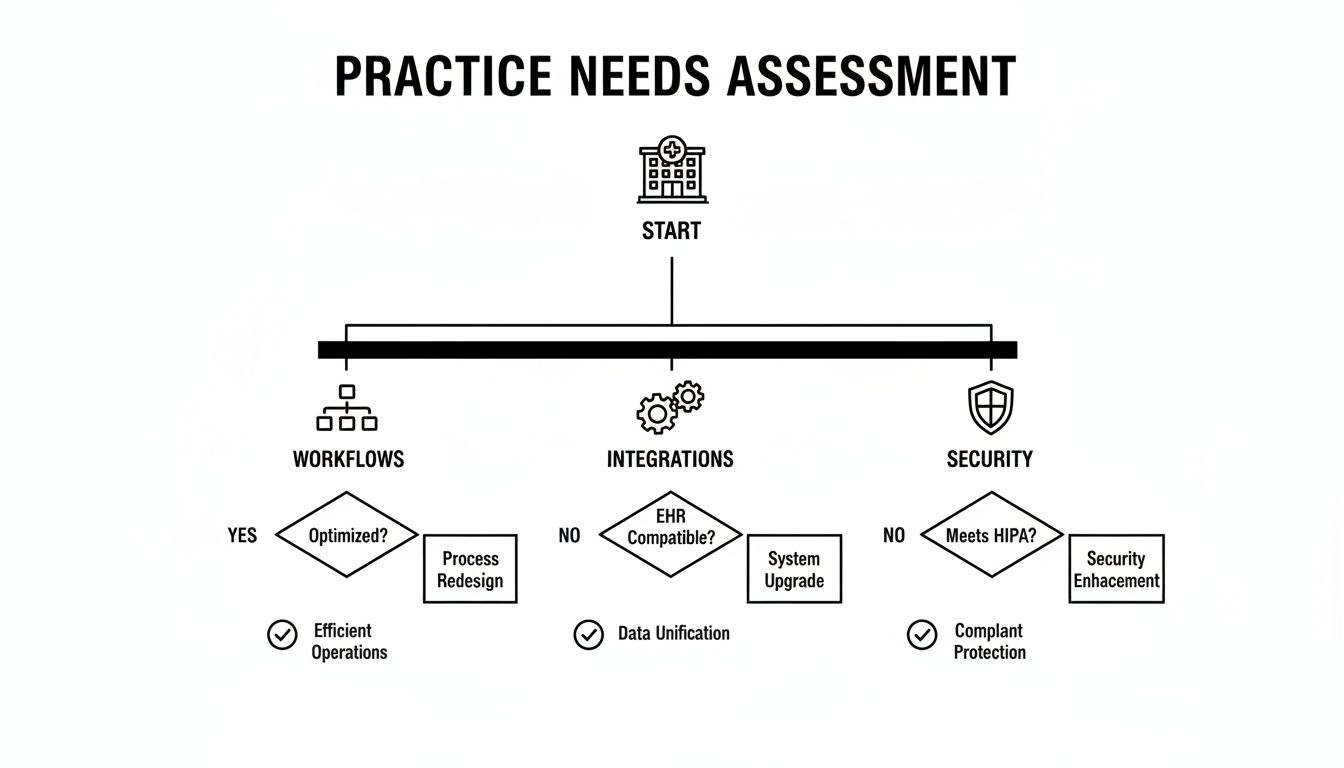
As you can see, your perfect EMR is right at the intersection of operational efficiency, seamless connectivity, and rock-solid security. With that in mind, let's see how some of the top contenders really stack up.
Practice Fusion: An Accessible Option for Small Clinics
Practice Fusion has long been a go-to for new or smaller practices, largely because its cloud-based platform offered an easy entry point. Its core strength has always been providing the essentials—charting, e-prescribing, and patient scheduling—without a huge upfront cost. For the most part, the interface is straightforward, which means less time spent training staff.
However, the business model has changed over time, so you need to look closely at the total cost. While it handles the basics well, practices with specialized needs might hit a wall. If you need advanced aesthetic treatment templates or have a concierge membership model, you'll likely find its customization options too limited. It's a solid foundational EMR, but you might have to create workarounds for anything outside the standard primary care model.
Ideal Use Case: New or small primary care practices that need a low-barrier-to-entry EMR with solid, fundamental features and don't require deep workflow customization or specialized billing modules.
athenahealth: A Powerhouse for Billing and Revenue Cycle Management
It's impossible to talk about EMRs without mentioning athenahealth. It's a dominant player, and for good reason: its revenue cycle management (RCM) service is baked right into the system. This EMR is fundamentally built around the financial health of your practice. It uses a massive network of billing rules and data to help maximize reimbursements and shut down claim denials. If insurance billing is one of your biggest headaches, this integrated approach is incredibly compelling.
The trade-off for all that financial muscle can be complexity and cost. It’s an extensive platform, and a small private practice might feel like they’re navigating a system built for a massive hospital group. While powerful, its clinical charting and workflow tools can feel clunky and less flexible compared to more modern, nimble platforms. When you choose athenahealth, you're buying into an entire ecosystem—which can be a huge asset for some, but total overkill for others.
Ideal Use Case: Established, insurance-based private practices that prioritize optimizing their billing operations and are willing to invest in a robust, network-driven platform to improve their revenue cycle.
Jane App: A Favorite for Wellness and Solo Practitioners
Jane App has built a fiercely loyal following among wellness practitioners—think physical therapists, chiropractors, and mental health professionals. The entire platform is designed around simplicity and a great user experience, both for you and your patients. Clean charting, seamless online booking, and integrated payments are its bread and butter.
That intense focus on simplicity means it doesn't have the sophisticated clinical decision support or complex reporting you’d find in a larger EMR. Jane shines for practices that are primarily direct-pay or have straightforward insurance billing needs. It's fantastic at getting the administrative busywork out of your way so you can focus on patient care. Many practices love it to start but find they need to transition to a more complete solution as they scale. For more insight on how different platforms serve a growing practice, you can learn more about the best practice management software in our comprehensive guide.
Ideal Use Case: Solo practitioners, cash-based clinics, and wellness practices that value an elegant, all-in-one system for scheduling, charting, and payments with an exceptional user interface.
Kareo: A Comprehensive Suite for Independent Practices
Kareo positions itself as a one-stop shop for independent practices by offering a suite of tools that includes a clinical EMR, billing software, and patient engagement solutions. This modular approach is nice because you can pick and choose what you need, which can be a smart, cost-effective way to go. The platform is built specifically for the outpatient world and is generally easy to use.
The one thing to keep in mind with Kareo is that even though the components are meant to work together, they can sometimes feel like separate products that have been bundled. This can create a bit of friction between the clinical and billing sides of your workflow. That said, its strong telehealth integration and solid features make it a versatile option for a wide range of private practices looking for a comprehensive solution without enterprise-level complexity.
Ideal Use Case: Independent private practices of all sizes that want a flexible, modular platform to manage clinical, financial, and patient-facing operations under a single vendor.
DrChrono: A Mobile-First EMR for Modern Clinics
DrChrono made its name by being one of the first EMRs built from the ground up for the iPad. That mobile-first philosophy is still its biggest selling point. It’s designed for physicians who want the freedom to chart, prescribe, and run their practice from anywhere. People especially praise its customizable medical forms and speech-to-text features, which make documenting on the fly incredibly efficient.
The flip side is that the desktop experience can sometimes feel like an afterthought. It's fully functional, but it isn't always as polished or intuitive as the app. DrChrono also offers integrated billing and RCM services, making it a strong all-around choice for tech-savvy practices that value mobility and modern design.
Ideal Use Case: Tech-forward private practices and providers who primarily use tablets for clinical work and desire a seamless, mobile-centric EMR experience with robust customization options.
Selecting the Right EMR Demands a Situational Approach
As you can tell, there’s no single "best" EMR for every private practice. The right choice depends entirely on your specific situation. A concierge practice has completely different needs than a high-volume primary care clinic. A medical spa's workflow is nothing like that of a mental health provider.
The key is to match the platform's core strengths to your practice's primary goals.
- If your biggest pain point is billing, a system like athenahealth is worth a serious look.
- If you are a solo practitioner prioritizing simplicity and patient experience, Jane App could be the perfect fit.
- If mobility is non-negotiable, DrChrono's platform is designed for you.
Ultimately, the best EMR for your private practice is the one that just works, fading into the background so you can run your business efficiently and focus on what really matters: delivering exceptional patient care. It should feel less like a tool you’re forced to use and more like a partner in your success.
The Hidden Costs of Juggling Multiple Vendors

When you're looking for the best EMR for a private practice, it's easy to focus just on the software itself. But the real story is often about the entire web of technology you build around it. Many practices end up in a tricky spot, patching together different systems from different companies. You might have one vendor for your EMR, another for scheduling, a third for billing, and a fourth for telehealth.
On the surface, this "best-of-breed" approach makes sense—pick the top tool for each task. But it almost always leads to a tangled mess of operational headaches, hidden expenses, and serious security vulnerabilities. Trying to manage 8 to 12 different software vendors isn't just inefficient; it’s a direct threat to your practice's growth and your team's sanity.
Data Silos and the Integration Nightmare
Every time you bring a new vendor into the mix, you’re creating another isolated island of data. Your scheduler doesn't automatically sync with your EMR, which doesn't talk to your billing platform. This disconnect forces your staff to spend countless hours on manual data entry, which is not only tedious but also opens the door to costly human errors.
And then there are the integration failures. Vendors love to promise seamless connections, but the reality is often a series of broken workflows and endless troubleshooting. For a private practice without a dedicated IT department, this becomes a massive drain. You often need outside help to fix things, which is its own kind of headache. You can get a better sense of these challenges in our guide to managing medical practice IT support.
The true cost isn't just about the money you spend. It’s the operational drag—the hours your team wastes fighting with software instead of focusing on patients. Every minute spent on a technical workaround is a minute you never get back.
The Security and Training Burden
Your practice's security is only as strong as its weakest link. Each new piece of software you add is another potential entry point for a breach. Suddenly, you’re trying to manage HIPAA compliance across a dozen different systems, which is a logistical nightmare and a huge risk.
The training burden is just as heavy. Instead of mastering one cohesive platform, your team has to learn the ins and outs of multiple, often clunky, interfaces. This complicates onboarding for new staff and creates constant friction for your existing team as they struggle to remember different workflows. It’s a fast track to frustration and burnout.
This problem is even more pressing when you look at the EMR market itself. Just two vendors control a staggering 69% of the ambulatory EHR market. This kind of consolidation creates serious vendor lock-in and interoperability headaches, and private practices feel the pain the most. A single, vertically integrated stack flips this script entirely, bringing all your core functions together in one secure, unified system.
Solving the Private Practice Dilemma with Ragnar STACK
The constant battle with "vendor sprawl" is more than just an annoyance for private practices; it's a genuine obstacle to growth. When you're forced to juggle separate systems for your EMR, billing, scheduling, and patient messaging, you create a messy, disconnected environment full of data silos and security risks. This setup forces your team to play IT support, pulling them away from what actually matters: patient care.
Ragnar STACK was built from the ground up to solve this very problem. Instead of trying to tape together a bunch of different software, our platform provides a single, cohesive ecosystem. Every tool is designed to work in harmony because it was all built together. This isn't just a matter of convenience—it's a fundamental shift in how your practice can operate.
A Unified Platform Built for Cohesion
The real power of Ragnar STACK lies in its unified architecture. When your EMR, patient portal, and billing systems are all part of the same platform, data moves between them securely and without a hitch. There are no broken integrations to troubleshoot, no mind-numbing manual data entry, and no vendors pointing fingers at each other when something goes wrong.
You get a single source of truth for your entire practice. This not only makes your day-to-day work more efficient but also creates a rock-solid foundation for compliance and security, since all your data is managed under one consistent protocol.
A vertically integrated system, by its very nature, eliminates the typical points of failure you see in a multi-vendor setup. You're no longer managing a dozen different relationships and security policies; you have one partner and one secure, unified environment.
This cohesion leads directly to a less stressful, more productive clinic. Your team can actually focus on their jobs without being constantly derailed by software glitches—a huge factor in reducing burnout. You can find more of our thoughts on this by exploring our resources on EMR support for private practices.
Tailored Workflows for Specialized Practices
A one-size-fits-all EMR simply doesn't cut it anymore. The best system for a private practice has to adapt to its unique clinical and business needs. Ragnar STACK is specifically built for the demands of high-performance clinics.
- For Medical Spas: Our system helps you manage the entire client journey, from the first online booking to handling treatment packages and memberships. We've even built tools for before-and-after photo galleries and inventory tracking directly into the patient record.
- For Primary Care & Wellness: We support comprehensive care with robust patient portals, automated reminders for preventive care, and smooth workflows for chronic disease management.
- For Specialty & Concierge Clinics: You can elevate the patient experience with features designed for high-touch service. Things like concierge coordination, tiered membership management, and VIP patient services are native to the platform, letting you deliver that white-glove care without the administrative headache.
This level of focus means the platform actually enhances how you already work, instead of forcing you into a generic, rigid box.
The Tangible Benefits of a Single Ecosystem
Making the switch to a single, integrated platform like Ragnar STACK offers clear, measurable benefits that solve the biggest headaches of vendor sprawl. It’s about more than just having fewer logins to remember.
Key Advantages of Ragnar STACK:
| Benefit | Impact on Your Private Practice |
|---|---|
| Reduced Overhead | Stop managing multiple vendor contracts, support tickets, and renewal dates. This drastically cuts down on administrative work and costs. |
| Single Point of Support | When you need help, there's just one number to call. Our team understands your entire tech setup, leading to faster, more effective solutions. |
| Unified Compliance | A single system makes HIPAA compliance much simpler. With unified audit trails and security protocols, you reduce your practice's overall risk. |
| Seamless Data Flow | Patient info, appointments, and billing data move flawlessly across the platform. This eliminates errors and frees up valuable staff time. |
At the end of the day, choosing Ragnar STACK is about more than a better EMR. It's about adopting a smarter, more sustainable technology strategy. By consolidating your systems into one powerful ecosystem, you free your practice from the hidden costs of a fragmented setup and build a foundation for real, patient-focused growth.
A Few Common Questions About Choosing an EMR
Picking the right EMR for your private practice goes way beyond a simple feature list. You have to think about the real-world stuff: how long will this take to set up, what happens to all our patient data, and what's the real final cost? Answering these questions early on will save you headaches down the road and help you choose a partner, not just a product.
What’s a Realistic Timeline for Getting an EMR Running?
Getting a new system off the ground isn't an overnight process, but it shouldn't take forever either. For most small to mid-sized private practices, a realistic implementation timeline is somewhere between 4 to 8 weeks.
It usually breaks down into four main steps:
- Discovery and Planning (1-2 weeks): This is where you and the EMR team map out your practice's unique workflows. They'll help you customize templates and settings so the system actually fits how you work.
- Data Migration (1-3 weeks): The vendor takes the lead here, carefully moving patient charts, notes, and billing records from your old system into the new one.
- Staff Training (1-2 weeks): Your team gets hands-on with the new software. Good training is non-negotiable—it's what makes or breaks the transition and keeps your practice running smoothly.
- Go-Live and Support (Ongoing): The switch is flipped. A good EMR partner will provide extra support during these first few weeks to iron out any kinks as they pop up.
One thing that can really speed this up is choosing a vertically integrated platform. When you aren't trying to wrangle multiple vendors for different tools, the whole process becomes much simpler.
How Do I Handle Moving All Our Data From the Old System?
Data migration can feel like the scariest part of switching EMRs. The thought of losing patient data or messing up records is enough to keep anyone up at night. This is why you need a partner with a rock-solid, proven process for managing the entire transition.
Your vendor should handle everything—from securely extracting the data to reformatting it for the new system and loading it correctly. But the most important step? Thorough data validation. After the transfer, they must confirm every single patient record is complete and accurate. It’s the only way to ensure continuity of care without missing a beat.
Before you sign any contract, ask for a detailed data migration plan. A trustworthy vendor will be completely transparent about their process, including how they clean up data, how they validate it, and what kind of support you'll get during the switch.
What Other Costs Should I Expect Besides the Monthly Fee?
The sticker price you see is rarely the final price you pay. It’s frustrating, but many practices get blindsided by "hidden" fees that can seriously inflate the total cost. When you're evaluating the best EMR for your private practice, insist on getting a complete and honest pricing breakdown.
Make sure you ask about these common extra charges:
- Implementation and Setup Fees: A one-time cost to get the system configured for your practice.
- Data Migration Charges: Some vendors will bill you separately just to move your existing data over.
- Training Costs: Basic training might be included, but personalized or extra sessions often cost more.
- Customization Fees: Need a special template or a unique workflow? That could be an added charge.
- Integration Fees: The cost to connect your EMR to outside services like labs, pharmacies, or billing platforms.
To avoid nasty surprises on your invoice, look for a provider that offers a simple, all-inclusive pricing model. A single, predictable fee is always better than a low starting price with a long list of potential add-ons.
By bringing all your technology into one cohesive ecosystem, Ragnar STACK gets rid of the complexity and hidden costs that come with juggling multiple vendors. We offer one unified platform for your entire practice, giving you seamless operations and pricing you can actually count on. Learn more at https://notes.rstack.io.
Share This Story, Choose Your Platform!
LISTEN NOW

CAPTIVATING READS

Our blog is packed with articles and stories based around lifestyle, business, design and wellbeing. Subscribe now to get all of our updated directly to your inbox every week.