
The way patients find a new doctor has completely transformed. It used to be about word-of-mouth or a listing in the Yellow Pages. Now, it all starts with a search engine. A solid local SEO strategy isn't just a marketing nice-to-have anymore; it's a fundamental part of running a modern medical practice. It's how you connect with people in your community the very moment they need care.
Why Local SEO Is a Must-Have for Your Practice's Growth
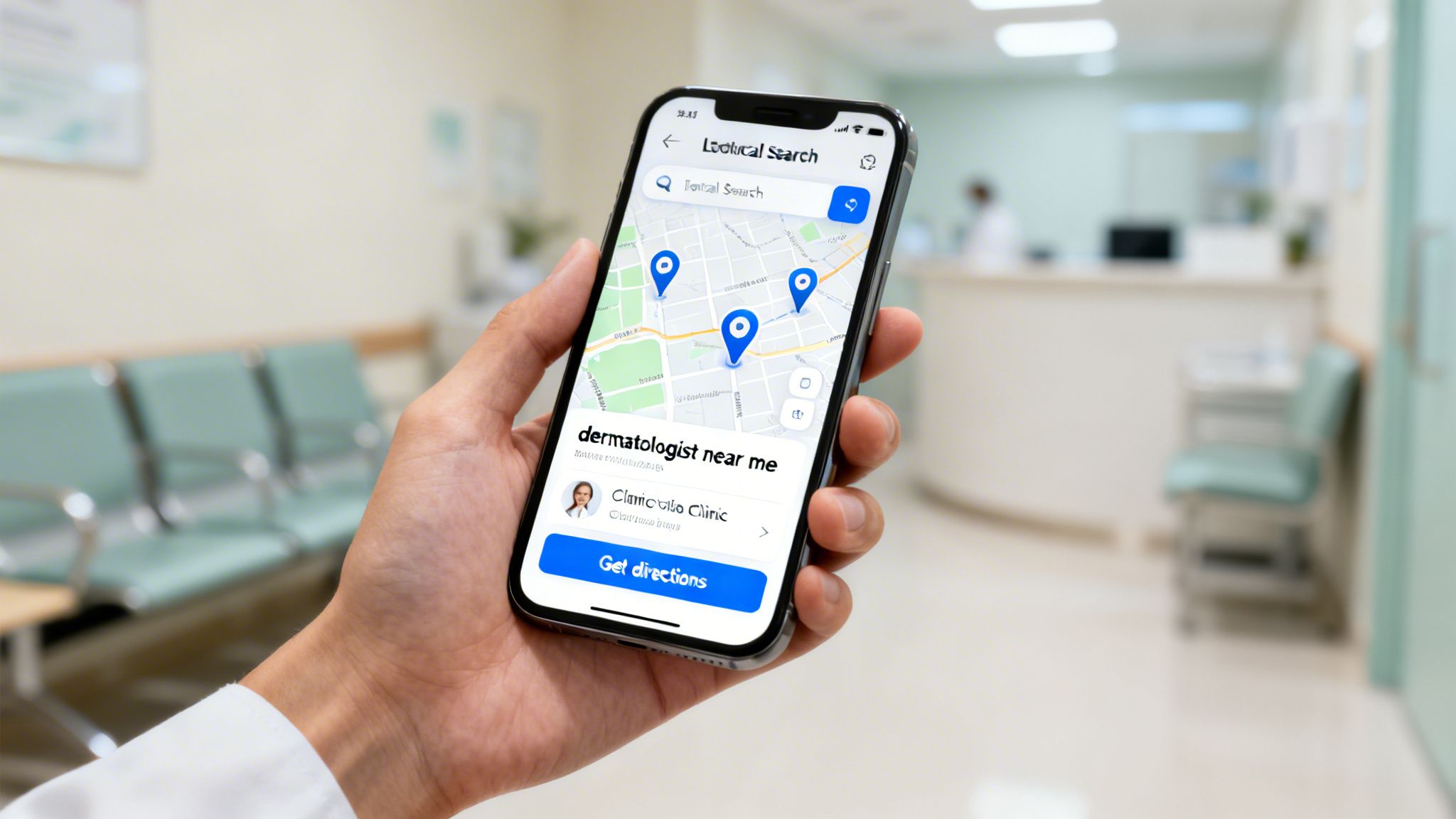
Think about it. When someone needs a doctor, their first move is to pull out their phone and type "pediatrician near me" or "urgent care open now." Showing up at the top of those results isn't just about getting seen—it's about being the immediate, obvious answer for someone actively looking for help.
This isn't just a trend; it's the new reality. Research consistently shows that over 80% of people use online searches to find local medical services. This shift from traditional methods to digital search is profound, and practices that don't adapt will get left behind.
To really grasp this change, let's look at how things used to be versus how they are now.
How Patients Find Doctors Today vs Yesterday
The table below breaks down the old-school methods against today's digital-first approach. It's a clear picture of why your online presence matters so much.
| Acquisition Channel | Reach & Intent | Modern Relevance |
|---|---|---|
| Yellow Pages | Limited to a physical area, no intent data. | Obsolete. Patients now expect instant, digital results. |
| Referrals | High-trust but low-volume and unpredictable. | Still valuable, but now supplemented by online reviews. |
| Local Ads | Broad reach but often lacks immediate patient intent. | Expensive, often less effective than targeted search. |
| Google Search | Hyper-local, captures high-intent patients actively seeking care. | Essential. The primary channel for new patient acquisition. |
| Online Directories | Targets specific healthcare searches, builds trust. | Crucial for confirming your practice's details and reputation. |
As you can see, the game has changed entirely. The patient journey is now overwhelmingly digital.
From Clicks to Appointments
Good local SEO does more than just get your name out there; it drives real-world results. When you optimize your online presence, you're not just playing a game with Google's algorithm. You're directly increasing appointment bookings and cementing your practice as a trusted local institution.
This playbook will walk you through exactly how to do that, focusing on three key outcomes:
- More Patients Through the Door: Attract people who are searching for the exact services you offer, right in your neighborhood.
- A Stronger Community Reputation: Build trust with positive reviews and accurate, consistent information online. This makes you the default choice in your area.
- Smoother Operations: When your digital marketing works hand-in-hand with your practice management software, you create a better patient experience from the first click to the final follow-up. Check out these technology solutions for healthcare that can make this integration seamless.
The goal of local SEO for doctors isn’t just to rank higher. It's to be the clear, credible, and convenient choice for a person in your community who needs medical attention right now.
By following the steps in this guide, you’re setting up your practice for sustainable growth. You’re making sure that when someone in your area searches for help, your practice is the first and best answer they find.
Getting Your Google Business Profile to Work for You
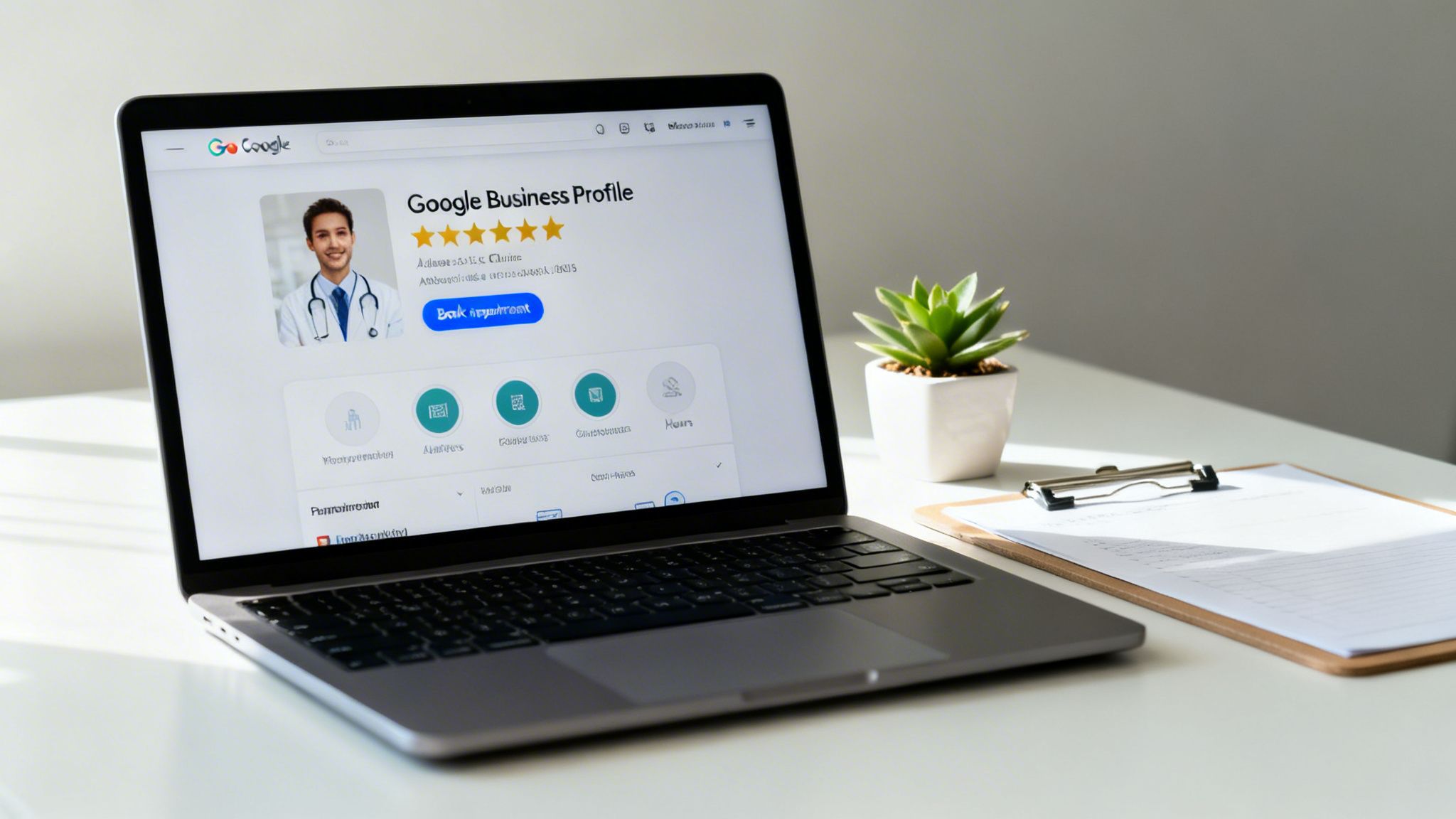
Let's be blunt: for most potential patients, your Google Business Profile (GBP) is your practice's front door. It’s often the very first thing they see, and it can single-handedly determine whether they click "Book Appointment" or just keep scrolling.
A neglected, bare-bones listing is a massive missed opportunity. A thoughtfully optimized one, on the other hand, builds instant trust and makes it incredibly easy for patients to take that next step. This isn't just about putting your name and address online; it's about crafting a digital snapshot that screams competence and care.
First Things First: Claim and Verify Your Profile
Before you do anything else, you have to claim and verify your profile. This is non-negotiable. Without it, you have zero control over the information patients see. Unclaimed profiles often become a breeding ground for misinformation—think incorrect hours, old phone numbers, or a wrong address—creating a terrible experience before a patient even has a chance to contact you.
Verification is simply Google’s way of making sure you are who you say you are. They'll typically mail a postcard with a PIN to your physical office address. It's a small hoop to jump through, but it ensures only you or your authorized manager can make official changes.
Moving Beyond the Basics of NAP
Every local SEO guide talks about NAP (Name, Address, Phone number) consistency. And yes, it’s the foundation. But for a medical practice, the details are what truly matter to both Google's algorithm and the real people searching for care.
Here’s where you need to get granular with your optimization:
- Drill Down on Medical Categories: Don't just list your practice as "Doctor." Get specific. Your primary category should be your main specialty, like "Family Practice Physician" or "Dermatologist." Then, add secondary categories like "Medical Spa" or "Pediatric Cardiologist" to capture more specific searches. This is how Google connects you to the right patients.
- Build a Comprehensive Service Menu: Use the "Services" feature to spell out everything you do. A cosmetic surgeon should list services like "Botox," "Laser Hair Removal," and "Facial Fillers." A primary care clinic can add "Annual Physicals," "Vaccinations," and "Chronic Disease Management." The more detail, the better.
- Add High-Quality, Trust-Building Photos: Show people what to expect. Post clear, professional photos of your office's interior and exterior, your friendly staff, and maybe even some of your modern equipment. It helps demystify the experience and makes your practice feel far more approachable.
Key Takeaway: Your digital presence is a direct reflection of your physical practice. Inconsistent or outdated information online can erode a patient's trust just as fast as a disorganized waiting room. Accuracy is everything.
Make Your Profile a Hub of Activity
A static profile is a weak profile. Google actively rewards businesses that use the engagement features built into their listings. This is your chance to connect with your community and show you’re invested in patient care.
Get Ahead of Questions with Google Q&A
The Question & Answer feature on your profile is a goldmine that most practices ignore. Patients can ask questions directly on your listing, and—here's the catch—anyone can answer them. You need to control that conversation.
Don’t wait for questions to roll in. Proactively seed this section yourself with the FAQs you get every single day.
- What insurance plans do you accept?
- Is parking available at your clinic?
- Do I need a referral to schedule a visit?
- What are your weekend hours?
By posting and answering these questions yourself, you provide clear, authoritative information right away. This simple step heads off patient confusion and prevents well-meaning (but potentially wrong) users from posting incorrect details.
Use Google Posts for Timely Updates
Think of Google Posts as a mini-blog that appears right on your search listing. It’s perfect for sharing timely news and updates that keep your practice top-of-mind for local patients. While you're busy optimizing your website and backend systems, which can get complicated, you can get helpful guidance on topics like medical practice IT support.
Your Website and Location Pages: Turning Clicks into Appointments
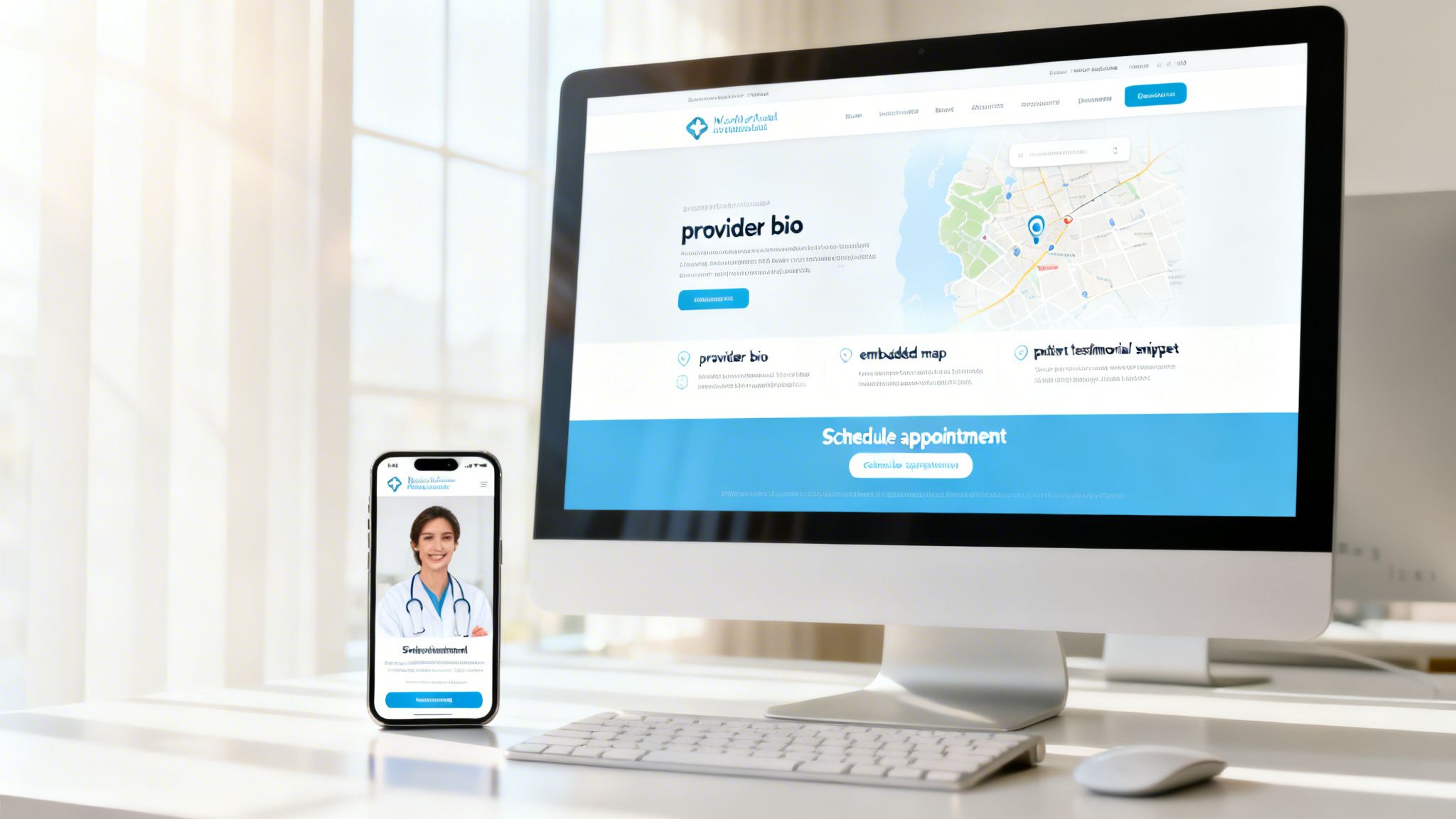
Getting that top spot on Google is a huge win, but that's only half the battle. Your Google Business Profile’s job is to earn the click; your website’s job is to secure the appointment. If a potential patient lands on a site that’s slow, confusing, or impossible to navigate on a phone, they're gone in seconds. That lost opportunity sends a negative signal right back to Google.
A truly patient-first website isn't just about looking good. It’s about creating an experience that’s clear, reassuring, and makes it incredibly easy for someone to book a consultation. We're talking fast load times, simple navigation, and obvious calls-to-action on every single page.
You Live and Die by Your Mobile Experience
I can’t stress this enough: your website's performance on a smartphone is everything. Patients are looking for care in real-time—often during stressful moments—and they are almost always on their phones. A clunky, hard-to-read mobile site is a direct barrier between you and a new patient.
Think about it. We know that over 50% of mobile users who search for a local business end up visiting one within a day. This statistic screams urgency, especially in healthcare. It proves that a seamless mobile experience isn't just a "nice-to-have"; it's an absolute necessity.
Your website has to work for the stressed-out parent trying to book a pediatrician appointment from their car in the school pickup line. If it’s not that easy to use, you’re losing patients. Period.
Anatomy of a Perfect Location Page
If your practice has more than one office, a generic "contact us" page just won't cut it. Each physical location needs its own dedicated page on your website. Think of it as a unique digital front door for each community you serve. These pages are absolute powerhouses for local SEO for doctors, helping each clinic rank for searches like “cardiologist in downtown Bellevue.”
A high-performing location page is so much more than an address. It’s a rich, trust-building resource packed with all the information a patient needs to choose you.
Here’s What Every Location Page Must Have:
- Unique Local Content: Don't just copy and paste the same blurb. Write a couple of paragraphs about that specific neighborhood, mention nearby landmarks, or share why you opened an office in that community. This proves to Google (and patients) that this page is distinct and valuable.
- Provider Bios: Feature the actual doctors and staff who work at that location. Including photos and brief, professional bios makes the practice feel human and approachable.
- Location-Specific Testimonials: Pull in reviews from patients who have visited that specific office. Localized social proof is incredibly persuasive.
- Embedded Google Map: An interactive, embedded map is a must. It's far more useful than a static image and lets patients get directions with a single tap.
- Crystal-Clear NAP and Hours: Make sure the full Name, Address, and Phone number (NAP) and the office hours are displayed prominently. Most importantly, they must match your Google Business Profile listing for that location perfectly.
Helping Search Engines Understand Your Practice
Beyond creating a great experience for people, you also need to feed search engines the right information in a language they understand. This is where Schema markup comes in. It’s a bit of code you add to your website that acts like a set of labels, telling Google things like, "This is a medical clinic," or "This is a physician who specializes in dermatology."
This behind-the-scenes step is crucial for earning rich snippets in search results—those little extras like star ratings or direct appointment links that make your listing pop. It helps Google understand your practice’s expertise, location, and services with total confidence. For the more technical side of your setup, you can integrate tools like healthcare practice management software to ensure all your systems are communicating properly.
Ultimately, implementing the right Schema gives Google the confidence to present your practice as the best, most relevant answer to a local patient’s search.
Building Trust Through Reviews and Local Listings
When a potential patient is searching for a new doctor, what's the one thing that matters most? Trust. Online, that trust is built on social proof. For a medical practice, this boils down to a two-pronged approach: mastering local business listings (citations) and encouraging a steady stream of patient reviews.
These two pieces work together. Consistent listings prove you're a legitimate local practice. Positive reviews prove you're a good one. Nail both, and you're sending powerful signals to Google and potential patients that your clinic is credible, active, and valued by the community.
Lock Down Your Digital Footprint with Local Citations
A local citation is simply any online mention of your practice's Name, Address, and Phone number (NAP). Think of them as digital signposts scattered across the web, all pointing back to your clinic. You'll find them on healthcare directories, local business sites, and data aggregators.
For medical practices, the name of the game is absolute consistency. I mean perfect consistency. A small difference, like using "St." in one directory and "Street" in another, can confuse search engines and weaken your local authority. It sounds trivial, but it really matters.
Where to Start? The Big Healthcare Directories
Focus your efforts on the platforms that patients actually use to find and vet doctors.
- Healthgrades: A major hub where patients research doctor credentials and share detailed feedback.
- Vitals: This one hones in on patient ratings for everything from bedside manner to office wait times.
- Zocdoc: A hugely popular platform for both finding doctors and booking appointments on the spot.
- Yelp: While it covers all local businesses, don't underestimate its influence. Patients definitely use it to review medical practices.
Your first step is to audit your practice's presence on these sites. Find every listing and check it for accuracy. If you find any inconsistencies, correct them immediately. The goal is a perfect NAP match across every single platform, mirroring exactly what's on your Google Business Profile and your website.
Your HIPAA-Compliant System for Getting Patient Reviews
While consistent listings lay the groundwork, it's the patient reviews that bring your reputation to life. In fact, more than 90% of patients now use online reviews to evaluate doctors. This isn't optional anymore; you need a proactive strategy for generating reviews.
Of course, in healthcare, you have to do this carefully to stay HIPAA compliant. The golden rule is to never disclose any Protected Health Information (PHI) in your review requests or public responses. The most effective—and compliant—method is often a simple, automated text or email sent after their visit.
Your request should be completely neutral. Just ask for general feedback on their experience. Most importantly, provide a direct link to the review platform you're targeting, like your Google Business Profile, to make it incredibly easy for them. Never, ever offer an incentive for a review.
Don't Just Get Reviews—Engage with Them
The work isn't over when a patient leaves a review. Responding to all feedback, whether it's a five-star rave or a one-star complaint, shows potential patients that you're listening and you genuinely care about their experience.
Handling Positive Reviews
- Make it personal. Thank the patient (by first name, if they use it) for taking the time to share their thoughts.
- Echo your values. You could say something like, "We're so glad we could provide a positive experience, as that's what our team strives for every day."
- Keep it short and sweet. A simple, genuine thank-you goes a long way.
Navigating Negative Reviews
- Acknowledge and validate their feelings. Start by thanking them for the feedback and saying you're sorry to hear about their frustrating experience. Avoid getting defensive at all costs.
- Take it offline immediately. This is crucial for HIPAA compliance. Provide a direct contact, like your office manager's name and phone number, so you can discuss their specific concerns privately.
- Show you're committed to improving. Reassure them (and everyone else reading) that you take feedback seriously.
This hands-on approach to your digital reputation does more than just help with SEO. It builds a foundation of trust that turns online searchers into new patients. You can find more ideas for building these connections by exploring strategies for patient engagement.
Creating Hyper-Local Content That Connects
All the technical SEO fixes in the world can get you on the map, but they won't make you a local authority. That's something you have to earn by becoming a genuine, trusted healthcare resource for your community. This means you have to move past the generic health articles that any practice, anywhere, could publish.
Your content needs to prove to both potential patients and search engines that you are an essential part of the local fabric. This is a critical piece of the puzzle for advanced local SEO for doctors because it creates powerful relevance signals that algorithms simply can't ignore.
Ditch the Generic Health Blogs
Take a minute and think about the specific health concerns, activities, and lifestyle of the people in your area. A cardiology practice in a high-altitude mountain town deals with a completely different local context than one in a dense urban center. Your content has to reflect that reality.
Sure, a post like "5 Tips for a Healthy Heart" is okay, but it doesn't exactly scream "local expert." Hyper-local content, on the other hand, directly connects your medical expertise to the community's day-to-day life.
Here’s what this looks like in the real world:
- An orthopedic clinic in Denver could publish a guide on, "Getting Ready for Ski Season: 5 Exercises to Prevent Common Knee Injuries on Colorado Slopes."
- A dermatology practice in Miami might create an article about "Sun Protection for Boaters: A South Florida Guide to Skin Safety on the Water."
- A pediatrician in Chicago could write a timely piece on, "Navigating Chicago's Best Parks Safely with Kids During Flu Season."
See the difference? This approach instantly positions you not just as a doctor, but as your community's doctor.
Build Links by Building Real Relationships
Backlinks are still a huge ranking factor. Think of them as votes of confidence from other websites. For a local practice, the most potent links you can get come from other respected local businesses and organizations. Instead of chasing mentions on massive national health sites, put your energy into building real-world partnerships that naturally result in digital connections.
This isn’t about sending out hundreds of cold emails begging for links. It's about actually embedding your practice in the community.
Expert Tip: The best local links are almost always a byproduct of genuine community engagement. Sponsoring a local 5K race isn't just a marketing line item; it becomes a powerful link-building opportunity when the event organizer adds a link to your practice on their sponsors' page.
Practical Ways to Build Local Links
Ready to get started? Here are a few actionable tactics that work time and time again:
- Sponsor a Local Youth Sports Team: Getting your practice's name on the jerseys is great for visibility, but the real SEO prize is the link you'll get from their official website back to yours.
- Partner with a Neighborhood Wellness Blog: Reach out to a local fitness or health blogger and offer to write a guest post. You give them valuable, expert content for their audience, and you get a highly relevant local backlink in return.
- Host a Community Health Workshop: Organize a free seminar on a topic people care about, like "Managing Seasonal Allergies in the Pacific Northwest." Make sure to invite local news outlets. A short feature on the community section of your local paper’s website is a gold-standard local link.
- Join the Local Chamber of Commerce: This is often low-hanging fruit. Most chambers have an online directory where they list and link out to all their member businesses. It’s an easy and authoritative first link to grab.
Every one of these actions sends a strong signal to Google that your practice is credible, active, and deeply rooted in its geographic area. This strategy shifts your marketing from simple advertising to meaningful community involvement—and that pays off in both patient trust and search engine rankings.
Pulling It All Together With an Integrated System
Let’s be honest, trying to run a great local SEO strategy often feels like a juggling act. You’ve got one system for booking appointments, another for texting review requests, a separate login for your website, and a handful of other tools for patient communication. It's a classic case of too many cooks in the kitchen.
This patchwork of systems creates friction. It wastes your staff's valuable time and, worse, leads to small inconsistencies that can quietly sabotage your online presence. Many practices are wrestling with 8-12 different vendors, and it's a surefire recipe for operational headaches.
From Tech Chaos to a Single Source of Truth
When your tools don't talk to each other, simple tasks become a grind. Think about ensuring your Name, Address, and Phone number (NAP) are identical everywhere—it becomes a tedious, manual chore where one typo can cause real problems.
The answer is to ditch the fragmented tech stack for a single, integrated platform. When your systems are built to work together from the start, you get rid of the data gaps and inefficiencies holding your practice back. Your entire operation starts running from a single source of truth.
Imagine this: a new patient finds you on Google and books an appointment right from your profile. That booking instantly appears in your practice management software. Then, after their visit, the system automatically sends a HIPAA-compliant review request. That's the kind of smooth, professional experience that’s only possible when everything is connected.
An integrated tech ecosystem doesn't just make your staff's lives easier—it creates a superior patient experience from their first Google search all the way through their follow-up care.
This kind of connected strategy allows you to turn your community involvement directly into marketing fuel. A simple community post can build momentum for a local event, which then gets picked up by local media.
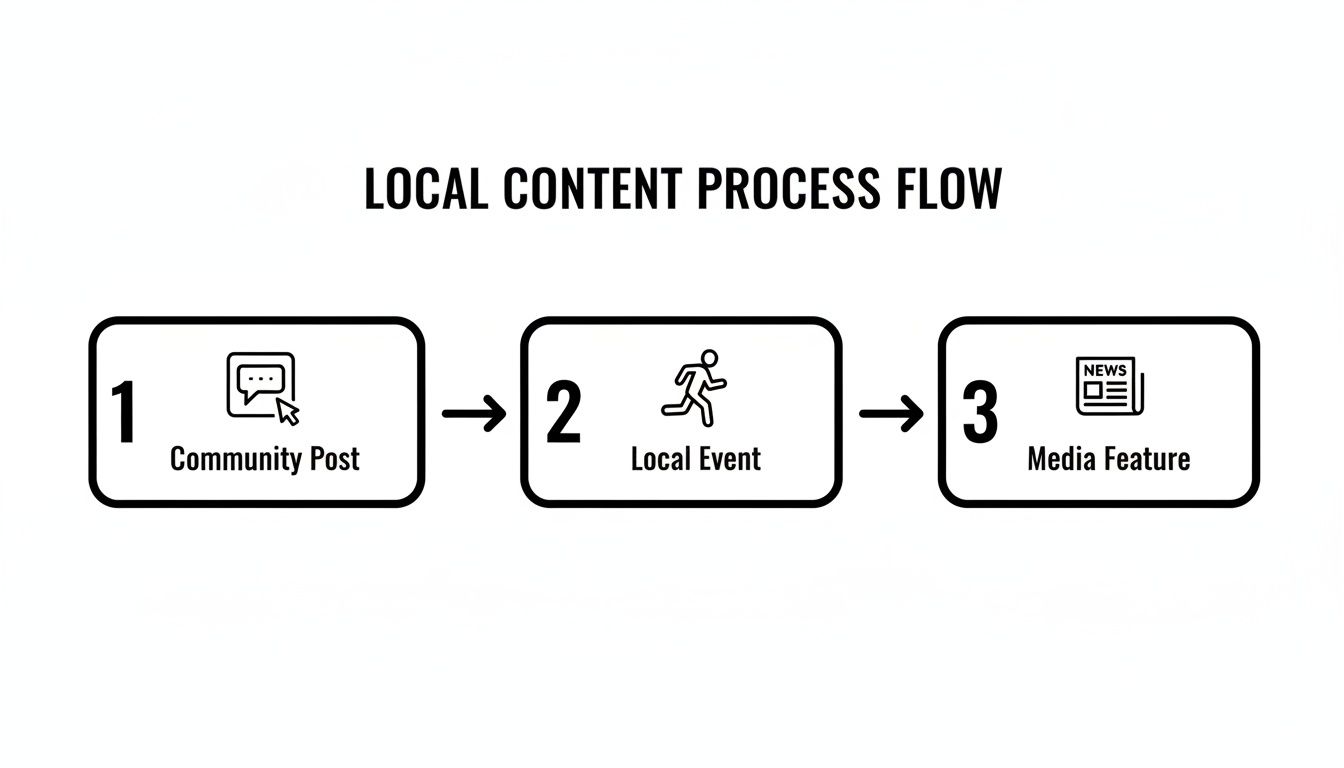
It’s a powerful feedback loop where one marketing activity naturally flows into the next, building on its own success.
The Real Advantage of a Single Platform
A truly integrated system like Ragnar STACK makes sure every moving part of your local SEO for doctors strategy is working in perfect harmony. The advantages over a piecemeal approach are massive.
- Perfect NAP Consistency, Every Time: When you manage your practice info from one central hub, it gets pushed out flawlessly to all your listings, from Google to the niche healthcare directories. No more manual updates.
- Set-and-Forget Review Generation: Link your scheduling system to your review platform, and you can automatically ask every patient for feedback. You’ll build a stellar online reputation without any extra work.
- One Partner, Not a Dozen: With a single ecosystem, you consolidate vendors, slash security risks, and have one number to call when you need help. It just simplifies everything.
This cohesion is what turns search engine traffic into loyal, long-term patients. You're not just getting found online; you're providing a seamless and professional experience at every digital touchpoint.
Common Questions We Hear About Local SEO for Medical Practices
Even with a solid game plan, it’s completely normal to have questions when you start digging into local SEO. We get them all the time from practice managers and physicians who are trying to figure out what to expect in terms of time, money, and overall effort.
Let's break down some of the most common questions that come up.
How Long Until We Actually See Results?
This is usually the first thing everyone wants to know. Unlike a pay-per-click ad that gets you on the map instantly, local SEO is more of a long game. It's about building a strong, trustworthy reputation online, and just like in the real world, that doesn't happen overnight.
Generally, you can expect to see some encouraging signs—like a bump in your local rankings or more website traffic—within the first three to six months. This is especially true if you’re starting from scratch with a profile that hasn't been touched. But getting to the top of a competitive market and staying there? That requires consistent, ongoing work.
What Should We Budget for Local SEO?
The next big question is always about the budget. The cost of local SEO for doctors can really run the gamut, depending on how competitive your city is and whether you're trying to do it yourself or bringing in an agency.
Instead of thinking of it as just another expense, frame it as an investment in bringing new patients through your door. What’s the average value of a new patient over their first year? If that number is, say, $1,500, then attracting just a handful of new patients each month from your SEO efforts delivers a massive return. A reasonable monthly investment can more than pay for itself in new appointments.
One of the biggest mistakes we see is treating SEO like a one-and-done project. It’s a continuous marketing function, just like managing payroll. The practices that consistently win are the ones who put in the consistent effort.
Can Our Staff Handle This In-House?
It’s tempting to try and keep everything in-house, and for some parts of local SEO, that can absolutely work. An office manager who's comfortable with technology can definitely handle tasks like updating your Google Business Profile or responding to patient reviews.
However, the deeper, more technical stuff often needs a specialist. Things like implementing schema markup correctly, cleaning up business citations across the web, and building local backlinks require a very specific skillset.
What works best for many practices is a hybrid model. Your team handles the day-to-day community engagement, while you partner with an expert for the heavy-lifting on the technical and strategic side. This way, all your bases are covered without burning out your internal staff.
Ragnar STACK eliminates the complexity of managing your practice's digital presence by unifying your tools into a single, seamless ecosystem. Stop juggling multiple vendors and discover how an integrated platform can drive real growth. Learn more at https://notes.rstack.io.
Share This Story, Choose Your Platform!
LISTEN NOW

CAPTIVATING READS

Our blog is packed with articles and stories based around lifestyle, business, design and wellbeing. Subscribe now to get all of our updated directly to your inbox every week.