

Effective marketing for a medical practice is about more than just running a few ads. It’s about building a comprehensive, multi-channel plan designed to attract the right kind of patients, earn their trust, and create a clear path to growth for your practice. The goal is to move beyond simple advertising and establish your practice as the go-to, authoritative healthcare provider in your community.
Success really boils down to three things: a crystal-clear understanding of your ideal patient, a powerful and consistent digital presence, and a unified message across every single platform you use.
Building Your Foundational Marketing Strategy
A winning marketing plan never starts with tactics like choosing which ads to run. It begins with a rock-solid strategic foundation. Without this essential groundwork, even the slickest, most expensive campaigns will fall flat, wasting both time and money.
Think of this foundational phase as creating the blueprint for your entire marketing house. It’s where you define who you are as a practice, who you're trying to serve, and what makes you stand out in a crowded healthcare market. Every marketing decision you make from here on out will be guided by this blueprint.
The process involves getting specific about your ideal patient, taking a hard look at your competition, and making sure your marketing efforts are plugged directly into your day-to-day operations.
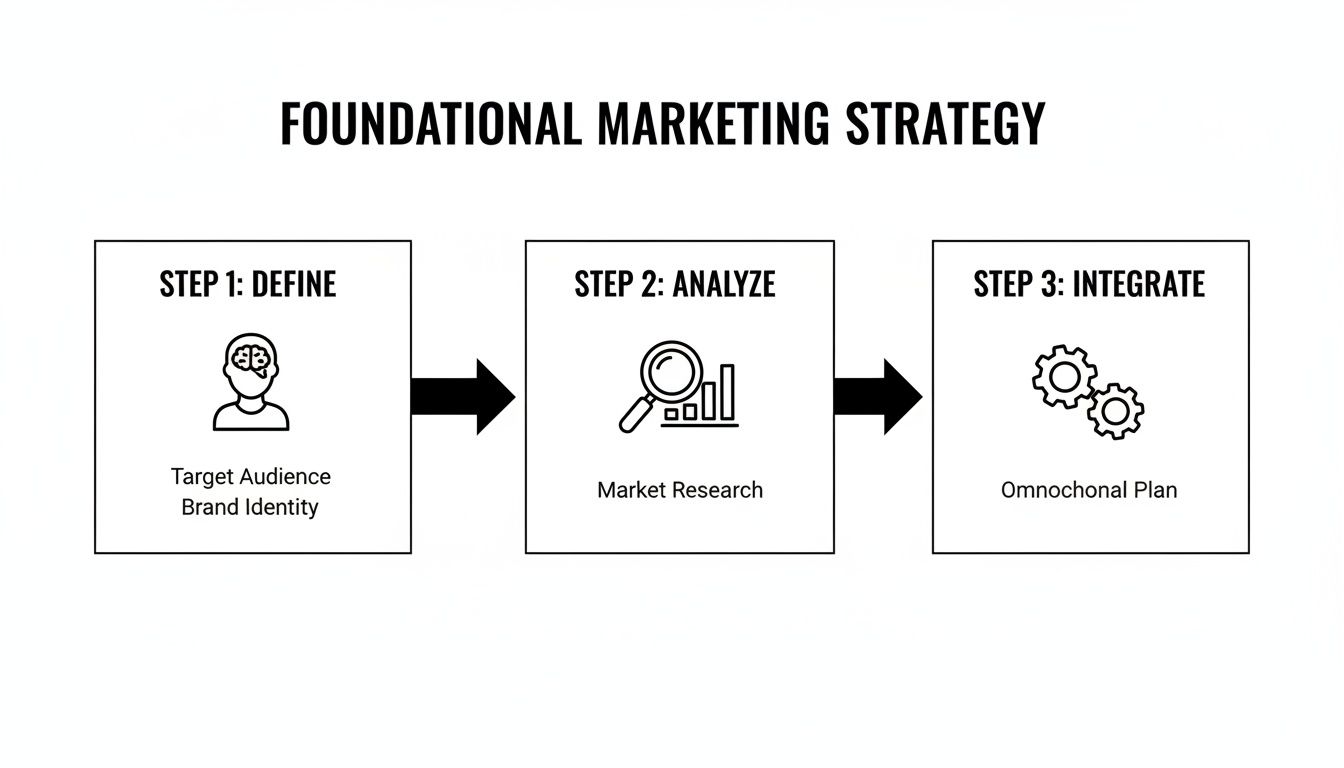
This workflow isn't just a diagram; it's a proven path. You start by deeply understanding your patient, then you analyze the market, and finally, you weave all your tactics into one cohesive, integrated plan.
Defining Your Ideal Patient
Let's be blunt: you can't reach your audience if you don't know who they are. This is where creating an "ideal patient persona" becomes a non-negotiable first step. It’s not just about basic demographics like age and gender; it's about digging into their motivations, their health challenges, and how they prefer to communicate.
Here are a couple of real-world examples:
- For a Medspa: Your ideal patient might be "Wellness Wendy." She's a 45-year-old professional who sees self-care as an investment. She researches new treatments extensively on Instagram and needs the flexibility of online booking after her workday ends.
- For a Pediatric Clinic: You might be targeting "New Parent Noah." He's 32, relies heavily on local parent groups on Facebook for doctor recommendations, and his top priority is finding a clinic that offers same-day sick visit appointments.
Knowing these specific details is a game-changer. It allows you to craft messages that actually resonate and choose the right channels to connect with these individuals authentically.
Conducting a Competitive Analysis
Once you know exactly who you're talking to, you need to understand the environment you're operating in. A competitive analysis is your reconnaissance mission—it helps you spot the gaps and opportunities right in your local market.
Who are the other primary care clinics or specialty practices in your service area? What’s their reputation? What are they really good at?
The single most important thing you'll get from a competitive review is your unique value proposition. What can you offer that nobody else does? Maybe it's specialized technology, an unmatched patient experience, extended hours, or a deep focus on a specific type of care.
This isn't about mimicking what your competitors do. It’s about carving out your unique space in the market and clearly articulating why a patient should choose you. That powerful differentiator becomes the cornerstone of every piece of marketing you create.
Integrating Technology for a Seamless Experience
Your strategy truly comes to life when it’s powered by the right technology. An integrated tech stack is what connects your marketing activities directly to your clinical operations, creating a completely frictionless experience for your patients.
In the healthcare world today, digital channels are king, capturing 72% of all ad budgets. This isn't a fluke; it's because the modern patient journey almost always starts on Google or social media. This reality means your marketing and operational systems have to talk to each other. You can get a deeper understanding by reading our guide on what practice management software is and how these systems fit together.
This table breaks down the core elements that should be part of any medical marketing strategy.
Core Components of a Medical Marketing Strategy
| Strategy Pillar | Objective | Key Activities & Metrics |
|---|---|---|
| Brand Identity & Positioning | To establish a unique, trustworthy brand that differentiates the practice in the local market. | Develop a unique value proposition (UVP), create brand guidelines, and track brand-related search volume. |
| Ideal Patient Persona | To deeply understand the target audience's needs, behaviors, and communication preferences. | Conduct surveys, analyze patient data, and create detailed persona profiles with demographics and psychographics. |
| Competitive Analysis | To identify market gaps, competitor strengths/weaknesses, and opportunities for differentiation. | Analyze competitor websites & SEO, monitor their social media, and perform a SWOT analysis. |
| Technology Integration | To create a seamless patient experience from first contact to ongoing care using an integrated tech stack. | Integrate CRM with EMR/PM systems, implement online scheduling, and track patient journey conversion rates. |
| Measurement & KPIs | To track performance, prove ROI, and make data-driven decisions for continuous improvement. | Define key metrics (e.g., Cost Per Lead, Patient LTV, appointment show rates) and set up analytics dashboards. |
Ultimately, a well-defined strategy, supported by the right tools and a clear understanding of your market, is what separates practices that thrive from those that just get by.
When your tech is integrated, a new patient who finds you through a Google Ad and books an appointment online has their information flow instantly into your EMR. This operational backbone ensures your marketing isn't just generating leads—it's efficiently turning them into happy, loyal patients. It's no surprise that 79% of providers now rely on SEO and their websites as primary tools for attracting new patients.
Mastering Local Search and Medical SEO
For most medical practices, marketing isn't about casting a wide national net. It's about showing up for the patient who lives just a few miles down the road. This is where local search and medical SEO become your most powerful tools, turning your website into an engine that works around the clock to bring in new patients.
It's all about making sure that when someone searches for "urgent care near me" or "best pediatrician in [Your Town]," your practice is the one they see first. Dominating the local search results means getting your online profiles, website content, and technical details all working in perfect harmony. Think of it as setting up your digital storefront on the busiest street in town—which, for all intents and purposes, is Google.

Nail Your Google Business Profile
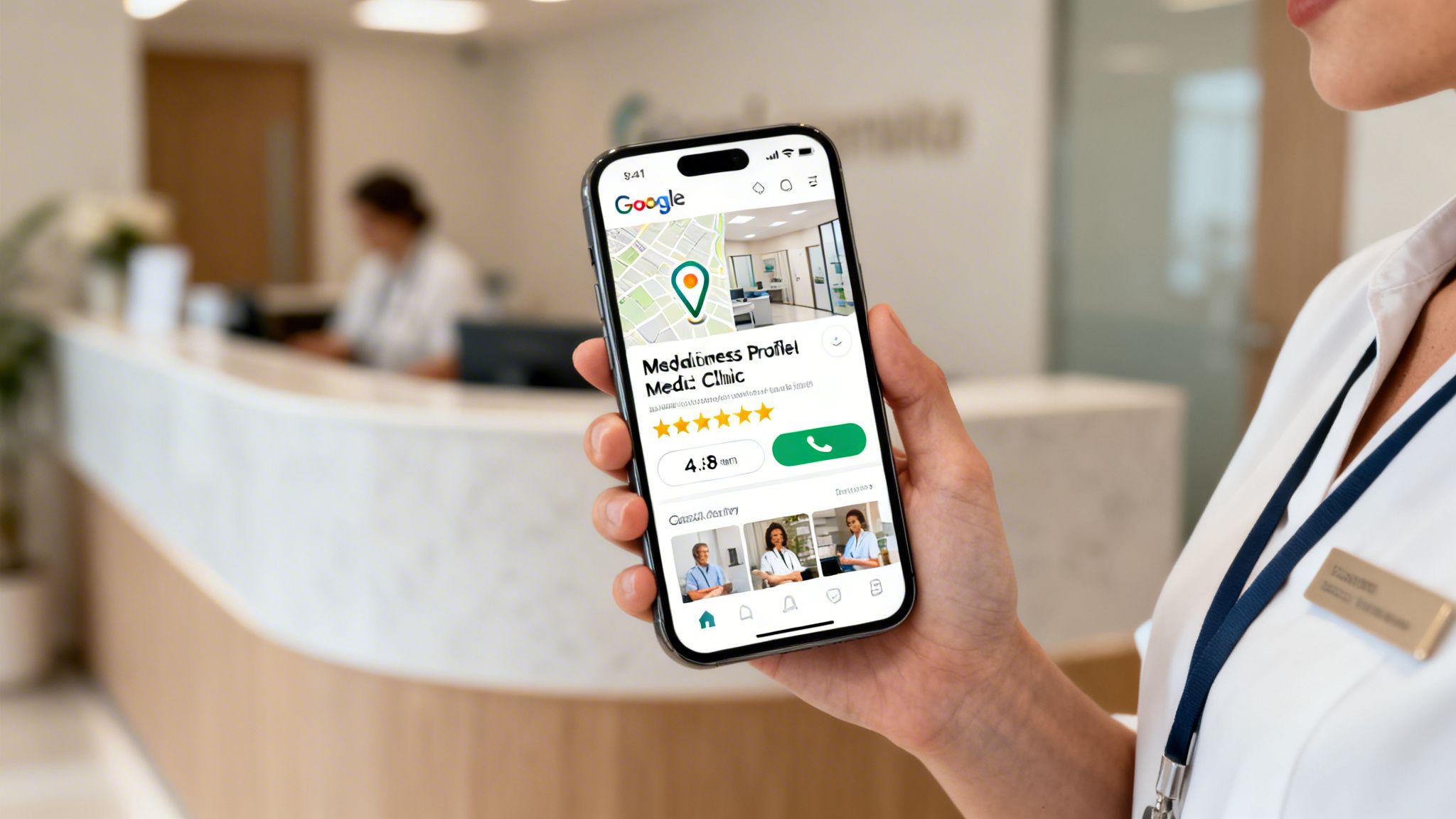
If you do nothing else for your local marketing, get this right. Your Google Business Profile (GBP) is the information box that pops up in Google Maps and the coveted "local 3-pack" on search pages. Honestly, it's the single most important piece of your local SEO puzzle. An incomplete or inaccurate profile is a huge red flag for both potential patients and Google's algorithm.
Optimizing your GBP is a straightforward but meticulous task. It's your first chance to build trust and visibility, so every detail matters.
Here's what you need to lock down:
- Verify Your Listing: The first step is claiming your profile so you have full control.
- Keep Your NAP Consistent: Your Name, Address, and Phone number (NAP) must be identical everywhere online—your website, social media, and every directory. Even a small difference like "St." versus "Street" can confuse search engines and hurt your rank.
- Upload High-Quality Photos: Show, don't just tell. Post clear pictures of your office's interior and exterior, your friendly staff, and any key equipment. This makes your practice feel real and welcoming before a patient even walks through the door.
- Encourage and Respond to Reviews: A steady stream of positive reviews is gold. But just as important is your response. Make a point to reply to all reviews, both good and bad, in a timely, professional, and HIPAA-compliant way.
Focus Your Website on Local Patient Needs
Once your GBP is dialed in, turn your attention to your website. On-page SEO is all about crafting your website's content to directly answer the questions local patients are asking. That means getting specific, being helpful, and targeting your geography.
Don't just have a generic "Services" page. Create dedicated pages for each of your core offerings. A page titled "Top-Rated Pediatric Services in Brooklyn" will attract far more relevant traffic than a vague page simply called "Our Services."
I've seen that modern patients don't just search for doctors; they search for solutions. Your website content needs to reflect this shift. Answer common questions like, "What are the early signs of seasonal allergies?" or "When should I see a doctor for lower back pain?"
This approach instantly positions you as a helpful authority, not just another clinic trying to get an appointment. By weaving local keywords naturally into this genuinely useful content, you hit the sweet spot of medical SEO. On the back end, having the right technology solutions for healthcare ensures your site is not only optimized for search but is also fast, mobile-friendly, and fully HIPAA-compliant—all non-negotiable ranking factors today.
Build Authority On and Off Your Website
Finally, you need to send clear signals to search engines that your practice is a legitimate, authoritative healthcare provider in your community. This comes down to a bit of technical work on your site and building your reputation across the web.
Technical SEO can sound intimidating, but one of the most impactful things you can do is implement schema markup. This is just a snippet of code you add to your website that helps search engines understand precisely what kind of business you are. There are specific schema types for "Physician," "Medical Clinic," and "Hospital" that explicitly tell Google about your practice, your specialists, and the services you provide.
At the same time, you need to build local citations. This simply means getting your practice's name, address, and phone number listed consistently in reputable online directories.
Focus your efforts on these essential listings:
- General Directories: Yelp, Yellow Pages
- Health-Specific Directories: Healthgrades, Vitals, Zocdoc
- Local Listings: Your local Chamber of Commerce or community business pages
Every consistent listing acts as a digital vote of confidence, reinforcing your practice's location and credibility in Google's eyes. This powerful combination of a pristine GBP, locally focused content, and strong authority signals is what separates thriving practices from the ones that stay invisible online.
Driving Growth with Paid Ads and Content Marketing
While mastering local SEO builds your long-term digital foundation, sometimes you just need to get in front of patients right now. This is where a one-two punch of paid advertising and content marketing really shines. Paid ads give you immediate visibility to capture patients actively looking for care, while great content builds trust and cements your practice as the go-to authority over the long haul.
Think of it this way: paid ads are like putting up a billboard on the busiest highway, targeting drivers who are already looking for your exact exit. Content marketing is like becoming the trusted local expert everyone recommends because you consistently provide valuable, helpful advice. A winning strategy needs both the immediate impact of the billboard and the enduring trust of the expert.
Capturing High-Intent Patients with Google Ads
When a potential patient types "emergency dental services near me" or "sports physical for school" into Google, they aren't just browsing—they have an immediate need. Google Ads, specifically search campaigns, let you jump to the front of the line, placing your practice at the very top of those search results before they even scroll to the organic listings.
The secret to a profitable Google Ads campaign is laser-focused targeting. You’re not just throwing money at broad terms like "doctor." Instead, you zero in on specific, action-oriented keywords that signal someone is ready to pick up the phone and book.
Here’s what that looks like in the real world:
- For an Orthopedic Clinic: You’d target phrases like "knee pain doctor in Dallas," "shoulder surgery consultation," or "book orthopedic appointment."
- For a Dermatology Practice: Smart keywords would be "acne treatment Austin," "mole removal specialist," or "schedule dermatologist visit."
This kind of specificity ensures your ad budget is spent connecting with people who are most likely to become actual patients.
Reaching Niche Audiences with Social Media Ads
If Google Ads are for capturing existing demand, social media platforms like Facebook and Instagram are brilliant for creating it. This is especially true for elective or wellness-oriented services. Their incredibly detailed targeting options let you reach specific demographics and interest groups with almost scary precision.
Imagine you run a medspa launching a new anti-aging treatment. On Instagram, you could run a campaign that targets users based on:
- Demographics: Women, ages 40-65
- Location: Within a 15-mile radius of your clinic
- Interests: People who follow luxury skincare brands, show interest in wellness retreats, or engage with high-end beauty content.
This level of detail means you can place a compelling, visual ad right into the feed of your ideal patient, catching their eye even when they weren't actively searching.
Here's the catch: getting the lead is only half the battle. The healthcare industry is grappling with a massive lead conversion crisis. Shockingly, only 1 in 9 inquiries becomes a booked patient, often at a steep average cost of $53.53 per lead. Speed is everything—contacting a lead within five minutes can make them 10 times more likely to convert, yet many practices take an average of 47 hours. You can dig into more of this data on the medical practice lead conversion crisis on InfluxMD.com.
This statistic is a huge wake-up call. It proves you need an integrated system that doesn't just generate leads from ads but also empowers your front office team to follow up instantly.
Building Trust Through Authoritative Content
Paid ads get you quick wins, but content marketing is your long-term play for building unshakable trust and authority. The whole game here is creating and sharing genuinely valuable, educational, and non-promotional content that answers the common questions and worries of your target patients.
The goal is to become the first place people in your community turn to for reliable health information. When you consistently answer the questions they're already asking, you start building a relationship long before they ever need to make an appointment.
A robust content plan for a medical practice should include a mix of formats:
- Blog Posts: Think articles like "5 Early Warning Signs of Diabetes" or "How to Prepare Your Child for Their First Dental Visit."
- Videos: Create short, shareable videos of your physicians explaining a common procedure or debunking a health myth circulating on social media.
- Downloadable Guides: Offer a helpful PDF on a topic like "Managing Seasonal Allergies in Our City" in exchange for an email address.
Every piece of content must be optimized for search engines to pull in organic traffic over time. It also needs to be meticulously reviewed for accuracy and HIPAA compliance. This strategy doesn't just attract new patients; it builds a loyal community that sees your practice as a true partner in their health. When you balance paid media with a strong content engine, you create a powerful, sustainable way to grow.
Nurturing Patient Relationships for Loyalty and Referrals
Getting a new patient through the door is a win, but the real test of a successful practice is what happens next. The goal isn’t just a single appointment; it’s turning that patient into a loyal, long-term advocate for your care.Your marketing doesn't stop when the patient checks out. In many ways, that's when the most important work begins. This is your chance to build a relationship that lasts, fostering the kind of loyalty that generates powerful word-of-mouth referrals—the lifeblood of any growing practice.
Keeping the Conversation Going with Email Marketing
Email is still a fantastic, professional way to stay connected with your patients, but it has to be handled with extreme care for HIPAA compliance. A smart email strategy isn't about blasting promotions; it’s about delivering genuinely useful health information that reinforces your expertise and shows you care about their well-being.
Think of your email newsletter as a digital extension of the care you provide in the exam room. A monthly dispatch with seasonal health tips—like managing allergies in the spring or flu prevention in the fall—keeps your practice top-of-mind in a helpful, non-intrusive way.
Post-visit marketing is less about selling and more about educating and supporting. When a patient gets a practical tip from their doctor, it deepens the relationship and builds a tremendous amount of trust.
This absolutely requires a HIPAA-compliant email platform. Your standard marketing tools just aren't built to handle protected health information (PHI), and the risks of a breach are too high.
Automating Recalls and Preventive Care Reminders
People are busy. It's incredibly easy for routine check-ups and follow-ups to fall off their radar. This is where automated recall systems become a massive asset, boosting both patient health outcomes and your practice's bottom line.
These systems can take the manual work out of sending secure, personalized reminders for things like:
- Annual Physicals: A gentle nudge for patients to book their yearly wellness exam.
- Preventive Screenings: Targeted reminders for mammograms, colonoscopies, or other crucial tests.
- Follow-Up Appointments: Ensuring patients stick to their care plan after a specific diagnosis or treatment.
Automation frees up your front-desk staff from making hundreds of phone calls, making sure no one slips through the cracks. It's a proactive move that shows patients you’re invested in their long-term health. Of course, this all hinges on a secure and robust IT infrastructure. You can dig deeper into why specialized medical practice IT support is so critical for making these workflows possible.
Building a Patient Referral Program That Works
Your happiest patients are your best marketers. Period. A formal referral program gives them a clear and easy way to spread the word while feeling appreciated for their loyalty. The key is to make it feel genuine, not transactional.
Instead of a generic discount, think about more meaningful rewards. After a patient refers a new family, a handwritten thank-you note paired with a gift card to a local coffee shop or healthy cafe can feel much more personal and impactful.
The easier you make it, the more referrals you'll get. Give patients a few professional-looking referral cards to carry in their wallet or a simple digital link they can text to a friend. Most importantly, track every referral meticulously so you can promptly thank the person who sent them. That personal touch is what turns a simple referral into a powerful, community-building moment.
Measuring Marketing Success and Proving ROI
Throwing money at marketing without tracking the results is a bit like prescribing treatment without a diagnosis. You're just guessing. To really build a growth engine for your practice, you have to move past feel-good numbers like website clicks or Facebook likes.
The real goal is to draw a straight line from every dollar you spend on marketing to tangible outcomes—namely, new patient appointments and practice revenue. This takes a disciplined approach, focusing on the Key Performance Indicators (KPIs) that actually matter in a healthcare setting. It’s all about answering one simple question: "Is this working, and how can we prove it?"
The Three Metrics That Truly Matter
You could track a hundred different data points, but honestly, most of them are noise. Your focus should be on a handful of core metrics that directly reflect the financial health and growth of your practice. Think of these as telling the complete story, from what it costs to get a new lead to the total value that patient brings in over time.
Let's break down the essential trio:
- Cost Per Lead (CPL): This is your starting point. It tells you exactly how much you're spending to get a potential patient to raise their hand, whether that’s by filling out a form or calling your front desk. You just divide your total marketing spend by the number of leads you generated.
- Patient Acquisition Cost (PAC): This one takes it a step further. PAC measures the total cost to acquire an actual, paying patient. It’s your marketing spend, plus any related administrative costs, divided by the number of new patients who actually came in for an appointment.
- Patient Lifetime Value (LTV): This is the holy grail. LTV is an estimate of the total revenue a single patient will generate over their entire relationship with your practice. It shifts your focus from a one-time transaction to long-term patient loyalty and health.
From my experience, a healthy practice should be aiming for an LTV to PAC ratio of at least 3:1. In plain English, for every dollar you spend to get a new patient in the door, you should expect to see at least three dollars back over their lifetime. That’s a sustainable model for growth.
Tearing Down the Data Silos
The biggest roadblock I see practices run into is that their data is all over the place. Your CPL lives in your ad platform, your appointment schedule is in your EMR, and your revenue data is in your billing system. These data silos make it nearly impossible to connect the dots.
This is where having an integrated tech stack changes everything. When your marketing tools talk to your operational software, you create a single source of truth.
Think about it: when your systems are connected, you can see the entire patient journey. You can see that a patient clicked a specific Google Ad for "local sports medicine doctor," booked an appointment, and went on to complete a full course of physical therapy. You can then attribute the full revenue from that care right back to that initial ad.
This finally closes the loop between marketing spend and financial results. It provides undeniable proof of your return on investment (ROI) and turns marketing from a line-item expense into a predictable, revenue-driving machine.
Below is a quick reference table of the essential KPIs you should be tracking, what they mean, and what you should be aiming for.
Essential Marketing KPIs for Medical Practices
| KPI | What It Measures | Industry Benchmark/Goal | How to Improve It |
|---|---|---|---|
| Patient Acquisition Cost (PAC) | Total cost to acquire one new, paying patient. | Under $150-$300 per new patient (varies by specialty). | Optimize ad targeting, improve landing page conversion rates, refine your intake process. |
| Patient Lifetime Value (LTV) | Total projected revenue a patient will generate over time. | 3x your PAC (e.g., if PAC is $200, LTV should be $600+). | Improve patient experience, implement recall/reactivation campaigns, offer new service lines. |
| LTV:PAC Ratio | The ratio of patient value to acquisition cost. | 3:1 or higher. | Focus on increasing LTV and decreasing PAC simultaneously. |
| Lead-to-Appointment Rate | Percentage of leads (calls/forms) that become booked appointments. | 50-75% or higher. | Improve front desk phone scripts, use automated follow-up texts, simplify your online scheduler. |
| No-Show Rate | Percentage of scheduled patients who do not show up. | Below 10%. | Send automated appointment reminders (text/email), implement a clear cancellation policy. |
Keeping a close eye on these numbers is the first step. The real magic happens when you start using them to make smarter decisions.
Putting Your Data to Work
Data is only useful if it helps you make better decisions. A unified view of your marketing performance allows you to constantly tweak your strategy and allocate your budget more intelligently. For practices looking to get this level of insight, checking out the best practice management software can be a real eye-opener, showing how integrated systems make this all possible.
With clear attribution data in hand, you can confidently answer the tough questions:
- Which marketing channels are bringing in our most valuable patients (the ones with the highest LTV)?
- Should we put more budget into our Google Ads or invest that money in local SEO?
- Is our email newsletter actually getting former patients to come back for preventive care?
This is how you stop guessing. You start strategically moving resources to the campaigns and channels that deliver real, measurable results, ensuring every single marketing dollar is working as hard as possible to grow your practice.
Common Questions About Marketing for Medical Practices
Even with a solid plan, it's natural to have questions when you're wading into digital marketing. For a medical practice, the stakes feel even higher with patient privacy and trust on the line. Let's walk through a few of the most common questions I hear from practice owners and office managers.

How Much Should a Medical Practice Spend on Marketing?
There’s no magic number here, but a reliable rule of thumb for an established practice is to allocate 5-10% of annual revenue to marketing. If you’re a brand-new practice or you're pushing for aggressive growth, you’ll want to aim higher, probably in the 10-15% range, to really build that initial momentum.
The most important shift in mindset is to see marketing as an investment, not just another expense. Instead of getting stuck on the total dollar amount, focus on the return you're getting. You need to get really familiar with two key metrics: Patient Acquisition Cost (PAC) and Patient Lifetime Value (LTV).
As long as your LTV is significantly higher than your PAC—aiming for a 3:1 ratio is a great goal—you know your marketing dollars are working hard for you. This is where an integrated tech platform becomes essential, because it lets you connect the dots between what you spend and the actual patient revenue that comes in.
When you have that data, you can scale your budget with confidence, knowing that it’s directly fueling the practice’s growth.
What Are the Biggest HIPAA Compliance Risks in Digital Marketing?
The biggest risks always come down to protecting patient privacy and keeping Protected Health Information (PHI) secure. The trouble is, many of the marketing tools people use every day simply weren't built with healthcare in mind, which can create some serious landmines.
Here are a few of the most common mistakes I see:
- Using standard website contact forms or regular email for patient inquiries, which sends PHI across the web without proper encryption.
- Running retargeting ads based on a user’s interest in a specific condition or treatment.
- Replying to online reviews in a way that confirms someone is, in fact, a patient.
- Forgetting to get a signed Business Associate Agreement (BAA) from marketing agencies or software vendors who might come into contact with PHI.
To keep your practice safe, you have to insist on using secure, compliant communication channels. It’s also critical to train your team on what they can and can’t say on social media and to make sure every single vendor you work with signs a BAA.
Can My Small Practice Compete with Large Hospitals Online?
You absolutely can. In fact, being small is one of your best marketing advantages. You're never going to outspend a massive hospital system, but you can be faster, more personal, and far more authentic—and that's what today's patients are really looking for.
Your secret weapon is local SEO. Your goal should be to completely dominate the search results for your specific neighborhood and city. A perfectly tuned Google Business Profile, a steady flow of new patient reviews, and website content that speaks directly to the needs of your community can make you far more visible than a hospital for the searches that matter.
Hospital marketing is often bureaucratic and impersonal. As a private practice, you can:
- Build real, one-on-one connections in your community.
- Film your doctors for a simple "ask me anything" video series.
- Jump on social media and engage directly with patients.
That kind of authenticity is something money can't buy. It builds a foundation of trust that big, faceless institutions struggle with, and it's exactly what draws in patients who want to feel seen and heard.
At Ragnar STACK, we eliminate the complexity of managing multiple vendors by providing a single, vertically integrated ecosystem designed for modern healthcare. Our platform ensures seamless data flow and unified compliance, allowing you to focus on patient care while your technology drives growth. Discover how our purpose-built solution can transform your practice at https://notes.rstack.io.
Share This Story, Choose Your Platform!
LISTEN NOW

CAPTIVATING READS

Our blog is packed with articles and stories based around lifestyle, business, design and wellbeing. Subscribe now to get all of our updated directly to your inbox every week.